
World’s First Rum Brewed with High Ginjo-Aroma–Producing Fission Yeast Schizosaccharomyces japonicus

“JAPONICUS RHUM AGRICOLE” Launches Feb. 27, 2026 – A Made-in-Japan InnovationResearchers at Kumamoto University have announced the world’s first rum produced using the fission yeast Schizosaccharomyces japonicus, marking a breakthrough in fermentation science and craft spirits innovation. The new product, “JAPONICUS RHUM AGRICOLE,” goes on sale February 27.
Most alcoholic beverages worldwide—including beer, wine, whisky, rum, and Japanese shochu—are traditionally fermented using the budding yeast Saccharomyces cerevisiae. In contrast, S. japonicus belongs to a rare group known as fission yeasts. Among more than 1,400 known yeast species, only four are classified as fission yeasts, making this organism an unusual and scientifically intriguing alternative.
The project was led by Professor Tokio Tani of the International Research Center for Agricultural and Environmental Biology (IRCAEB), Faculty of Advanced Science and Technology. The team previously discovered that when S. japonicus is cultured under anaerobic conditions, it produces a striking ginjo-style aroma—similar to that found in premium Japanese sake. Building on this finding, the researchers developed proprietary “Kumadai strains”—named after Kumadai, the Japanese abbreviation for Kumamoto University—that are capable of producing high levels of fruity esters such as ethyl caproate (apple-like aroma), isoamyl acetate (banana-like aroma), and β-phenethyl alcohol (rose-like aroma). Some of these strains generate four to five times more of these aromatic compounds than conventional brewing yeasts.
One strain in particular, Kumadai M23, proved especially promising for rum production. While it produces up to ten times more ethyl caproate and four to five times more isoamyl acetate than standard brewing yeasts, it also generates relatively high levels of ethyl acetate. In beverages like shochu, ethyl acetate is often considered an off-flavor. However, in rum, ethyl acetate is a key aroma component contributing to complexity and brightness. What was once viewed as a weakness became a defining strength—unlocking a new sensory direction for rum.
The resulting “JAPONICUS RHUM AGRICOLE” offers layered aromas reminiscent of ripe banana and apple, with an elegant fruit-tea-like bouquet and a smooth, gently sweet finish.
Production is carried out in collaboration with Oishi Shuzo Co., Ltd. Two versions will be available starting February 27: a 700 ml standard bottle and a limited-edition 200 ml bottle (100 units) featuring a special Kumamoto University label designed by a graduate student from the university’s Graduate School of Education.
Originally isolated from strawberries in Japan in 1928, S. japonicus has long been studied in molecular and RNA biology. Its transformation into a platform for next-generation craft fermentation demonstrates how fundamental research can translate into real-world innovation.
By rethinking yeast biology, Kumamoto University researchers have turned a rare microorganism into a new frontier in global rum production—expanding the possibilities of flavor science and redefining what “Made in Japan” can mean in the world of spirits.
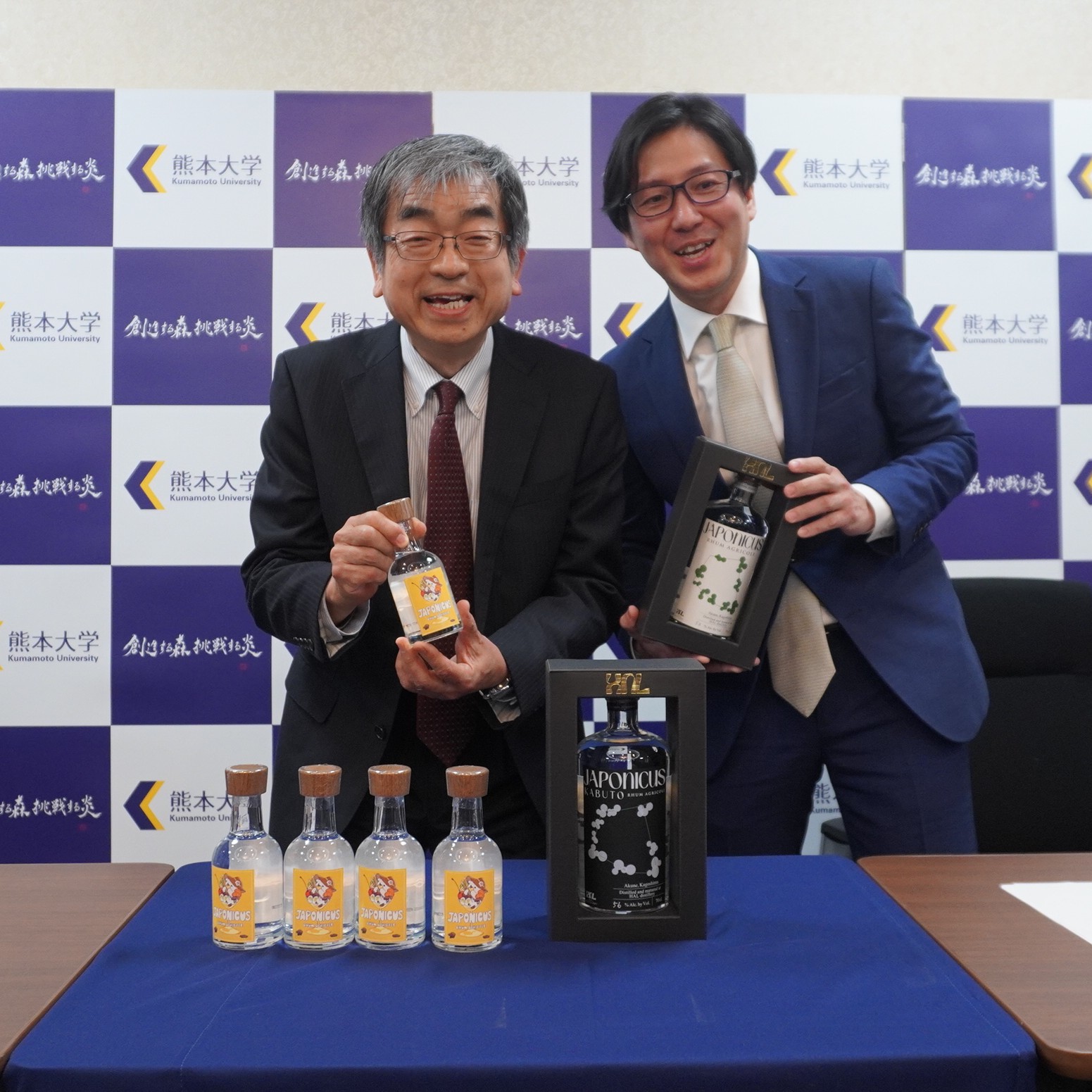
Image Caption: Professor Tokio Tani (left) holds the limited-edition bottle featuring a special Kumamoto University label, while Mr. Oishi, President of Oishi Shuzo Co., Ltd., presents the standard 700 ml bottle at the press conference.
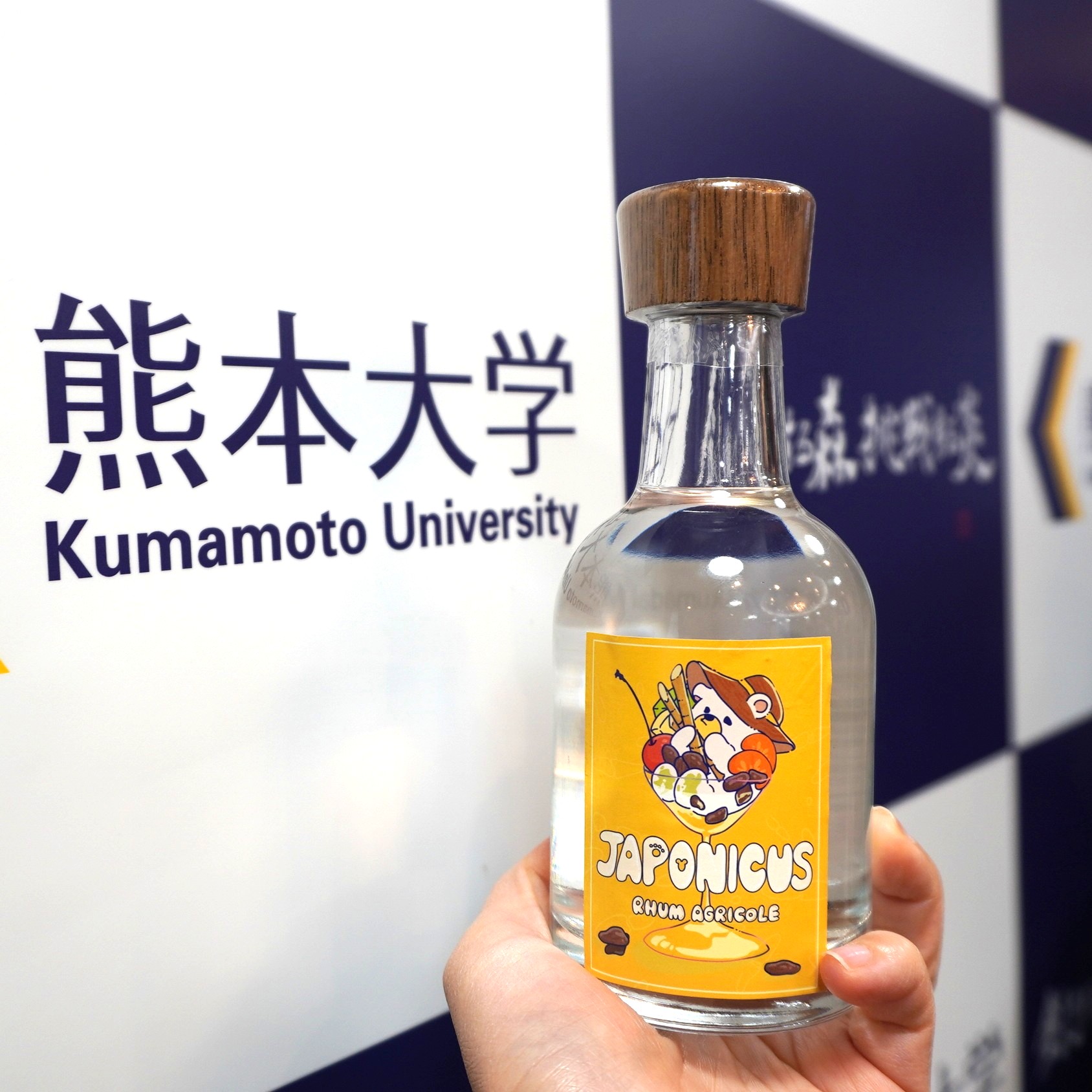
Caption: The limited-edition label design draws inspiration from Kagoshima, where the rum is distilled by Oishi Shuzo Co., Ltd. using locally sourced sugarcane. The artwork blends the image of Kagoshima’s beloved “shirokuma” (polar bear) motif—symbolizing regional sweetness—with Kumamoto University’s bear emblem (“kuma” means bear in Japanese), depicting a friendly polar bear in a cocktail glass. The soles of the bear’s feet subtly incorporate shapes representing both Kumamoto and Kagoshima prefectures, expressing regional collaboration. Vibrant fruit motifs highlight the rum’s fruity character, while the yellow and deep indigo color scheme reflects Kumamoto University’s official colors, creating a design that is both playful and distinctly university-inspired.