
Sleep Loss Linked to Higher Atrial Fibrillation Risk in Working-Age Adults

Objective one-week ECG monitoring study led by Kumamoto University finds shorter sleep significantly increases AF risk in people in their 50s, but not in retireesGetting enough sleep may be more important for heart health than many busy professionals realize. A new multicenter study conducted by researchers from Kumamoto University and the National Cerebral and Cardiovascular Center, has found that insufficient sleep is linked to a higher risk of atrial fibrillation (AF) among working-age adults.
AF is the most common type of heart rhythm disorder and is associated with serious complications such as stroke and heart failure. Although previous studies suggested a connection between sleep and AF, most relied on self-reported sleep data. This new research used an objective method: a one-week Holter electrocardiogram equipped with a built-in accelerometer to continuously estimate actual sleep duration during daily life.
The team analyzed anonymized data from individuals in their 50s—considered peak working age—and those in their 70s, representing retirement age. Among participants in their 50s, shorter sleep duration was significantly associated with a higher likelihood of AF. In fact, each additional minute of sleep was linked to a measurable reduction in AF risk. In contrast, no clear association was observed among participants in their 70s.
Interestingly, while longer sleep generally reduced AF risk, excessively long sleep did not provide additional benefit, particularly in older adults. The findings suggest that inadequate sleep may be a modifiable cardiovascular risk factor, especially for middle-aged individuals exposed to occupational stress and demanding schedules.
“Our results provide objective evidence that sleep duration matters for heart rhythm health, particularly in working adults,” said Dr. Tadashi Hoshiyama of Kumamoto University. “Securing sufficient sleep may help reduce the burden of atrial fibrillation.”
As modern lifestyles increasingly compress sleep time, these findings underscore a simple but powerful message: protecting your sleep may help protect your heart.
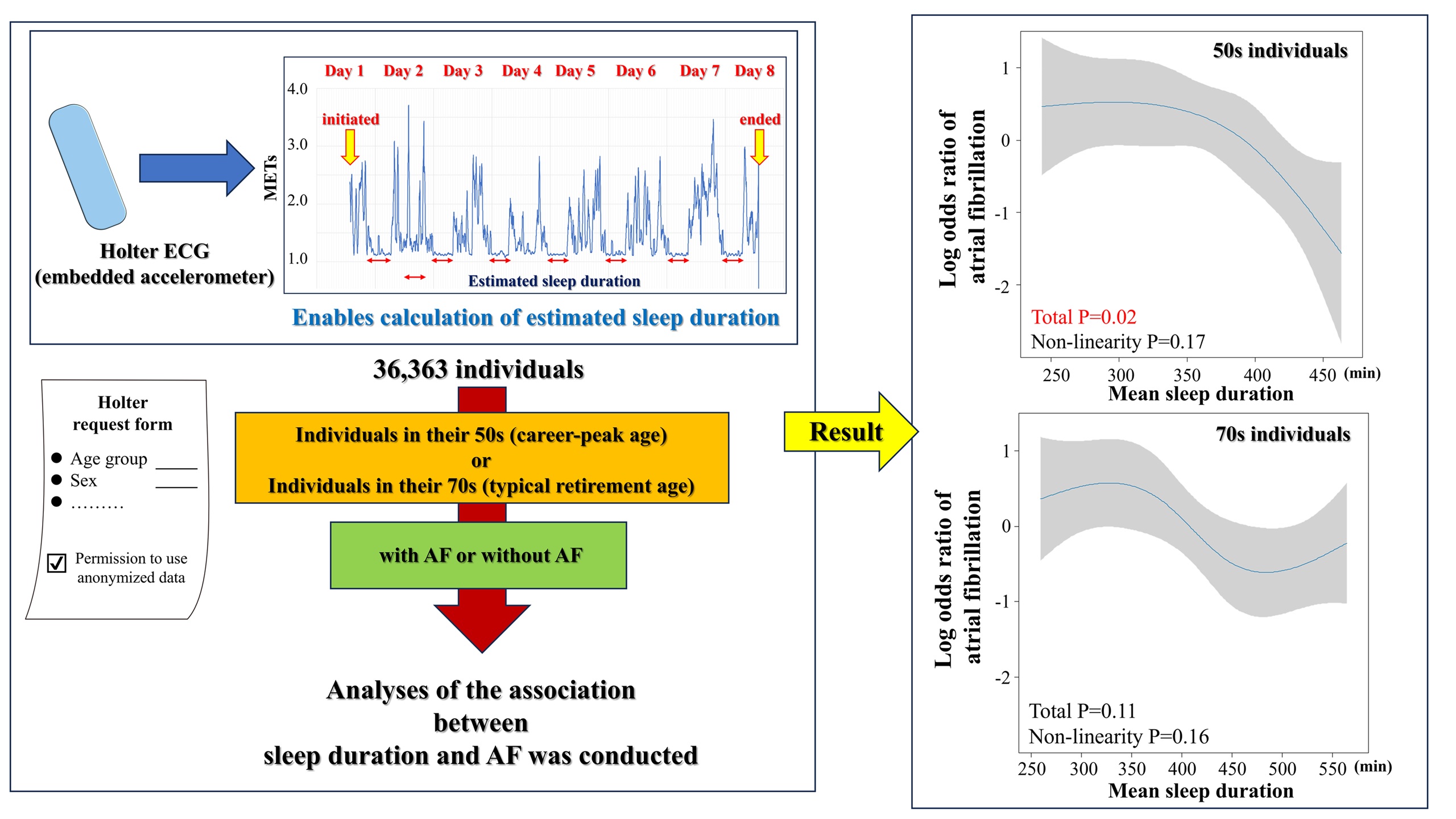
Image Title: Objective Assessment of Sleep Duration and Its Association With Atrial Fibrillation Risk
Image Caption:
Sleep duration was objectively estimated using a one-week Holter electrocardiogram (ECG) equipped with an embedded accelerometer, enabling continuous monitoring during daily life. The analysis included 36,363 individuals in their 50s (peak working age) and 70s (typical retirement age), with and without atrial fibrillation (AF). Logistic regression and restricted cubic spline analyses demonstrated that shorter sleep duration was significantly associated with higher AF risk among individuals in their 50s, whereas no significant association was observed in individuals in their 70s.
Reproduced from Hoshiyama T, et al. From Working to Retirement-Age—How Sleep Duration Is Related to Atrial Fibrillation Using 1-Week Holter-Electrocardiogram With Accelerometry—. Circulation Reports. 2025; doi:10.1253/circrep.CR-25-0310. © The Japanese Circulation Society. Distributed under the terms of the Creative Commons Attribution-NonCommercial-NoDerivatives 4.0 International License (CC BY-NC-ND 4.0).
Reference
| Authors |
Tadashi Hoshiyama, Kenichi Tsujita, Yuko Inoue, Masanobu Ishii, Koichiro Kumagai, Takahisa Noma, Kenzaburo Nakajima, Yoshihiro Kokubo,Masatoshi Koga, Naoki Mochizuki, Hisao Ogawa, Kengo Kusano |
| Title of original paper |
From Working to Retirement-Age—How Sleep Duration Is Related to Atrial Fibrillation Using 1-Week Holter-Electrocardiogram With Accelerometry— |
| Journal | Circulation Reports |
| DOI | 10.1253/circrep.CR-25-0310 |