
New Blood Test Offers Clearer Picture of “Clotting Risk” in Heart Disease Patients

Researchers at Kumamoto University have developed a highly sensitive blood test that can detect subtle differences in how easily blood begins to clot, offering new possibilities for tailoring anticoagulant therapy and understanding disease-specific clotting abnormalities in patients with cardiovascular disease.Blood clot formation is a tightly regulated process essential for stopping bleeding, but excessive or insufficient clotting can lead to life-threatening conditions such as thrombosis or severe bleeding. A key trigger in this process is the generation of tiny amounts of thrombin—a clot-promoting enzyme—at the very start of coagulation. Until now, this “initial thrombin generation” has been difficult to measure accurately in clinical settings.
In a large clinical study involving 771 patients with cardiovascular disease, the Kumamoto University team applied a newly developed high-sensitivity coagulation assay, known as SMAT, to quantify initial thrombin generation through two distinct pathways: the tissue factor (TF)–driven pathway and the FVIIIa/FIXa-dependent pathway.
The results showed that patients receiving direct oral anticoagulants (DOACs)—commonly prescribed blood-thinning medications—had markedly suppressed thrombin generation in both pathways. Statistical analysis demonstrated that this test could distinguish DOAC use with high accuracy, highlighting its potential as a practical tool to objectively evaluate whether anticoagulant therapy is exerting the intended effect.
Importantly, the study also revealed that underlying medical conditions influence clotting behavior in pathway-specific ways. Among patients not taking anticoagulants, those undergoing dialysis exhibited reduced thrombin generation across both pathways. Meanwhile, chronic kidney disease and active cancer were linked specifically to reduced thrombin generation via the tissue factor pathway. These findings suggest that different diseases alter the coagulation system in distinct patterns that conventional clotting tests may overlook.
“Our approach allows us to see the earliest spark of clot formation, rather than only the final outcome,” Associate Professor Yuichiro Arima from Faculty of Life Sciences, Kumamoto University notes. “This opens the door to more precise assessment of both clotting and bleeding risks, taking into account each patient’s medications and disease background.”
Beyond monitoring drug efficacy, the team suggests that pathway-specific thrombin profiles may eventually help predict clinical outcomes and guide more personalized treatment strategies. The study was published in Thrombosis and Haemostasis and represents a significant step toward more nuanced and clinically relevant evaluation of blood coagulation in cardiovascular medicine.
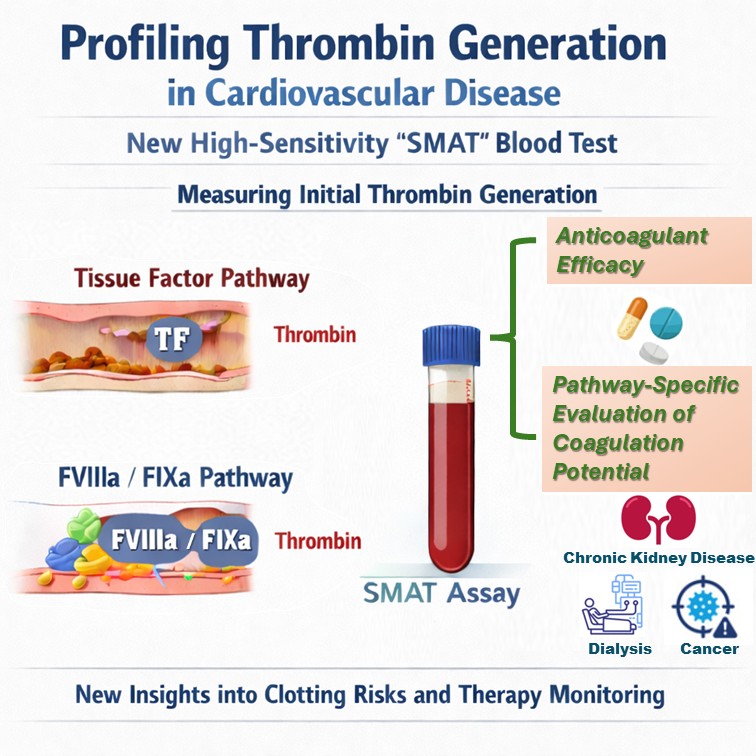
Image Caption: Using a high-sensitivity blood test (SMAT) that measures initial thrombin generation (ITG)—the very first step of blood clot formation—the researchers analyzed blood samples from 771 patients with cardiovascular disease. The results showed that ITG clearly differed depending on the use of anticoagulant drugs (DOACs or warfarin). In addition, ITG was reduced in patients with chronic kidney disease, those undergoing dialysis, and patients with cancer, revealing disease-specific patterns of blood coagulation.
Reference
| Authors |
Akira Fujiyama, Yuichiro Arima, Rina Inoue, Naoto Kuyama, Masahiro Yamamoto, Kyoko Hirakawa, Masanobu Ishii, Shinsuke Hanatani, Yasushi Matsuzawa, Eiichiro Yamamoto, Yasuhiro Izumiya, Mariko Komatsu, Yuichi Kamikubo, Kenichi Tsujita |
| Title of original paper |
Profiling Initial Thrombin Generation in Cardiovascular Disease using a High Sensitivity Coagulation Assay |
| Journal | Thrombosis and Haemostasis |
| DOI | 10.1055/a-2751-8379 |