2026 New Year’s Greeting from the University President

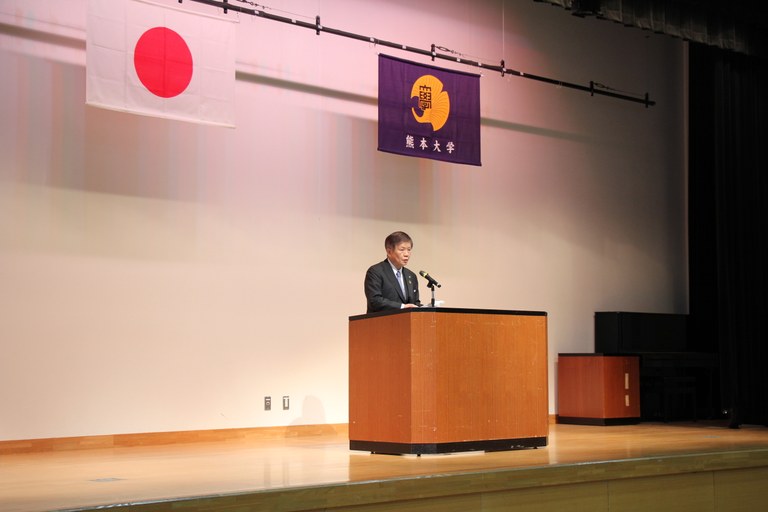
As we welcome the New Year, I extend my sincere greetings to all faculty and staff.
As President, I would like to express my deepest gratitude to each and every one of you for your continued dedication to the University’s education, research, medical services, and administration. Looking back on 2025, despite the challenging environment surrounding us, Kumamoto University has made steady progress in the areas of education and research, co-creation with society, and the provision of medical care. These achievements result from the dedicated efforts of our faculty and staff, to whom I again express my profound respect and appreciation.
Nearly five years have passed since I assumed the presidency in April 2021. Under the Kumamoto University Initiative 2030, we have continued to pursue our vision of becoming “an education and research hub contributing both locally and globally through ‘co-creation’ with society.” At the same time, we have upheld the principles of being “always communicating,” “always transparent,” and “always improving,” returning the fruits of our efforts to the region, society, and the world.
Kumamoto Prefecture is at the center of semiconductor industry development. While the growing concentration of semiconductor-related industries brings significant economic benefits to the region, it has also brought to the surface challenges such as shortages of industrial human resources and environmental burdens. We believe it is the responsibility of Kumamoto University to contribute, across the semiconductor field and beyond, through the cultivation of highly skilled human resources, leadership in the formation of industrial ecosystems, and support for, and leadership in, addressing regional challenges.
In order to fulfill this role, in 2024 Kumamoto University applied for and was selected under the Ministry of Education, Culture, Sports, Science and Technology’s Program for Promoting the Enhancement of Research Universities with Regional Cores and Distinctive Strengths (J-PEAKS). With the ten-year vision of becoming “a research and education university that leads the creation of a model city in a semiconductor cluster and attracts diverse talent from around the world,” we aim to realize regional innovation and build a sustainable industrial city through semiconductor implementation and research grounded in co-creation with society.
In addition, the research facility “SOIL (Semiconductor Open Innovation Laboratory),” completed in 2025, as a next-generation advanced research and semiconductor implementation hub in collaboration with industry, together with the adjacent education facility “D-Square,” established to train highly specialized human resources in semiconductors and information technologies, will generate synergies between research and education. Through interdisciplinary research and open innovation with other universities and industry, we will work to solve societal challenges and enhance Japan’s overall research capabilities.
Kumamoto University seeks to ensure that the positive impacts of advances in the semiconductor field extend beyond specific disciplines and permeate the entire University. To this end, we will further promote initiatives centered on “integration” and “globalization.” Here, “integration” goes beyond traditional science-humanities collaboration, encompassing the combination of semiconductors with life sciences, humanities and social sciences, and other diverse fields. Through such integration, we aim to create new research domains, social value, and even new industries. We believe that the semiconductor industry can achieve its next stage of growth—and sustain stable, long-term development—only through the creation of new interdisciplinary research areas and the expansion of new user industries leveraging semiconductor technologies.
In university education as well, in order to navigate an era of rapid social change and globalization, it is essential to cultivate individuals who possess multifaceted perspectives beyond their specific fields, can identify challenges on their own, and act proactively. Following the establishment of the “School of Informatics” in April 2024, we will launch the “School of Social Innovation” in April 2026. This new school will transcend disciplinary boundaries and offer interdisciplinary education incorporating management, international communication, and data science in a systematic manner, with the goal of nurturing individuals who can thrive in a global society.
Furthermore, alongside the establishment of the joint institute of teacher education in the Faculty of Education with Saga University and the reorganization of the Faculty of Letters into a single-department structure, we will introduce “International Classes” —the first of their kind among national university-attached schools in Japan, at the attached elementary school in April 2026 and at the attached junior high school in April 2027. Through these initiatives, we will promote the development of global human resources from the primary and secondary education stages.
Meanwhile, the financial environment surrounding universities is becoming increasingly severe. Rising personnel costs, utility expenses, and prices, along with the effective decline in management expense grant, are exerting significant pressure on our finances. How effectively we utilize our limited human and material resources has become a critical issue that will shape the University’s future.
Under these challenging financial conditions, it is essential to simultaneously advance efforts to secure external funding, improve operational efficiency, streamline and enhance organizational structures. Initiatives currently being pursued, such as naming rights, crowdfunding, and collaborative research, will become increasingly important as sources of revenue. At the same time, each faculty and staff member’s awareness and actions, including business transformation using DX (Digital Transformation) and sharing human resources and assets across organizational boundaries, will underpin the future management of the University.
At this juncture, as Japan faces a rapid decline in the population of 18-year-olds, the Ministry of Education, Culture, Sports, Science and Technology formulated the “Basic Policy for the Reform of National University Corporations” in November 2025, addressing the future of national universities in the fifth Medium-Term Goal period. In light of this policy, Kumamoto University will engage in active discussions on its mission and directions for functional enhancement, looking ahead to the fifth Medium-Term Goal period beginning in 2028 and beyond.
The history and traditions of Kumamoto University, dating back to the founding of the Fifth Higher Middle School in 1887, are a source of great pride. Yet, to preserve tradition, we must continue to change. In order for Kumamoto University to remain an institution needed by both the region and the world, I hope to share challenges with all faculty and staff and advance reforms together.
In closing, I sincerely ask for your continued understanding and cooperation in the year ahead and extend my best wishes for the New Year.
January 5, 2026
OGAWA Hisao, M.D., Ph.D.
President, Kumamoto University