
How Can AI Transform Education Without Leaving Anyone Behind?
International research team identifies five priorities for building human-centred, trustworthy and equitable education in the era of AI-agentsAs artificial intelligence (AI) rapidly enters classrooms and learning environments, how can societies ensure that its benefits reach learners and educators while avoiding new forms of inequality? A new international study led by Associate Professor Rwitajit Majumdar at Kumamoto University, Japan, provides a roadmap for responsible AI integration in education.
Published in Computers and Education Open, the study examined emerging trends and challenges in AI-supported education through a Delphi study involving 70 experts from 18 countries, representing academia, research, industry, policymaking and teaching. The research was conducted by an international team of researchers from institutions in Japan, Germany, Ireland, Australia, the Netherlands and Finland, bringing together diverse perspectives on the future of education.
The researchers identified five key priorities for AI in education. The highest-rated was AI-related competencies for learners and educators, highlighting the need for people to understand not only how to use AI tools, but also how to critically evaluate their outputs, limitations and ethical implications.
The second and third priorities were automated formative assessment and feedback and the evolving role of teachers working alongside AI agents. AI could provide students with rapid, personalised feedback, but the study emphasises that teachers will remain central to learning. Rather than simply adopting AI tools, educators may increasingly act as orchestrators of learning, combining AI capabilities with professional judgement.
Two further priorities—explainability and trustworthiness and accessibility and equal access—highlight an important challenge: technological progress alone does not guarantee better education. AI systems must be transparent, reliable and fair, while students from different socioeconomic, geographic and linguistic backgrounds must have equitable opportunities to benefit from them.
Importantly, the researchers argue that AI adoption should not be treated as a purely technological issue. Education is an interconnected ecosystem involving learners, educators, institutions, data, infrastructure, policies and society. Sustainable AI integration therefore requires coordinated action across research, educational practice and policymaking.
The study concludes that the future of AI in education should be built around human capability, pedagogical innovation, ethical governance and equity, positioning AI not as a replacement for educators, but as a tool to support teachers, empower learners and strengthen educational ecosystems.
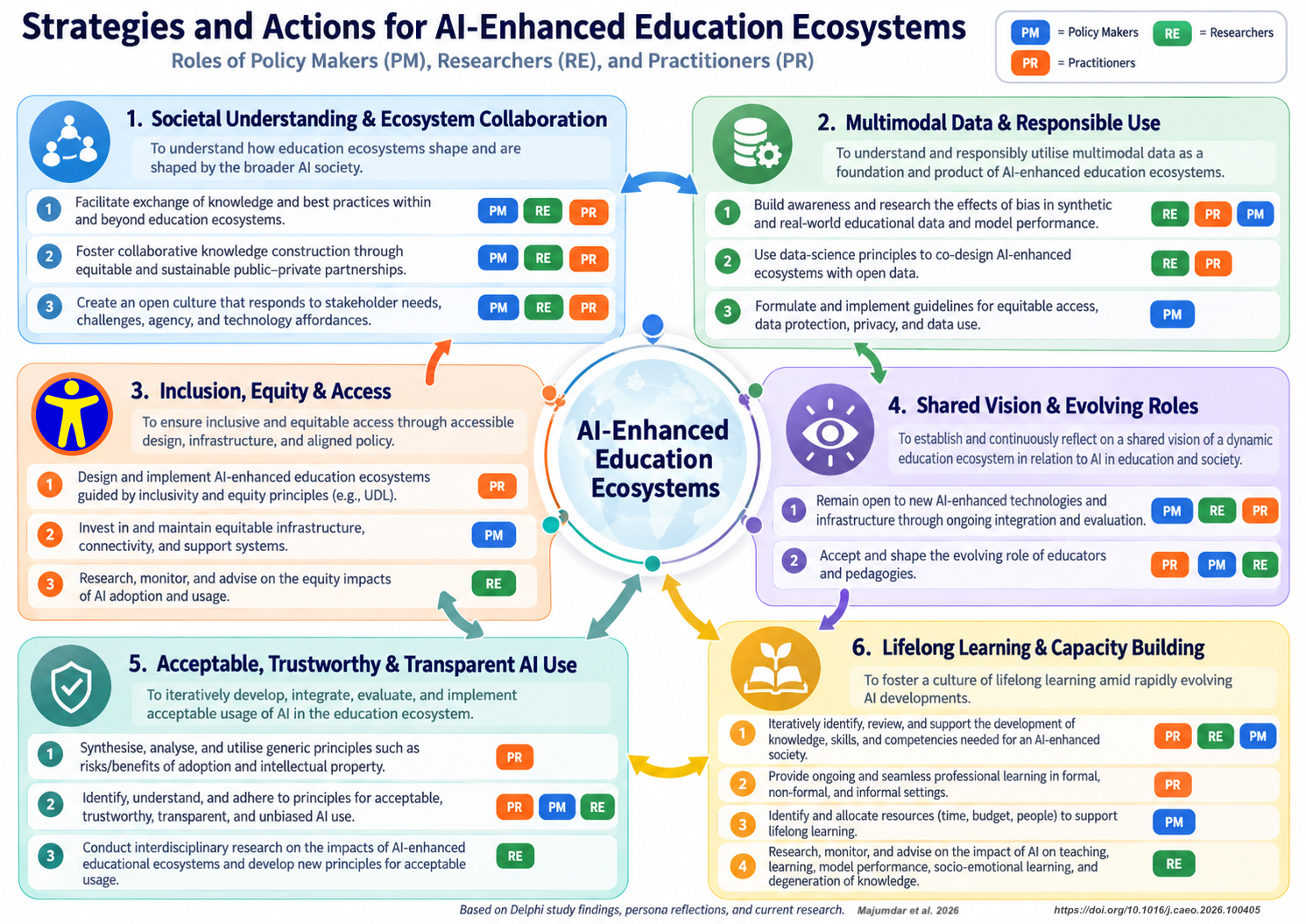
Image Caption: Overview of strategies and actions to mitigate the challenges of AI-integration in educational ecosystems that involves different stakeholders.
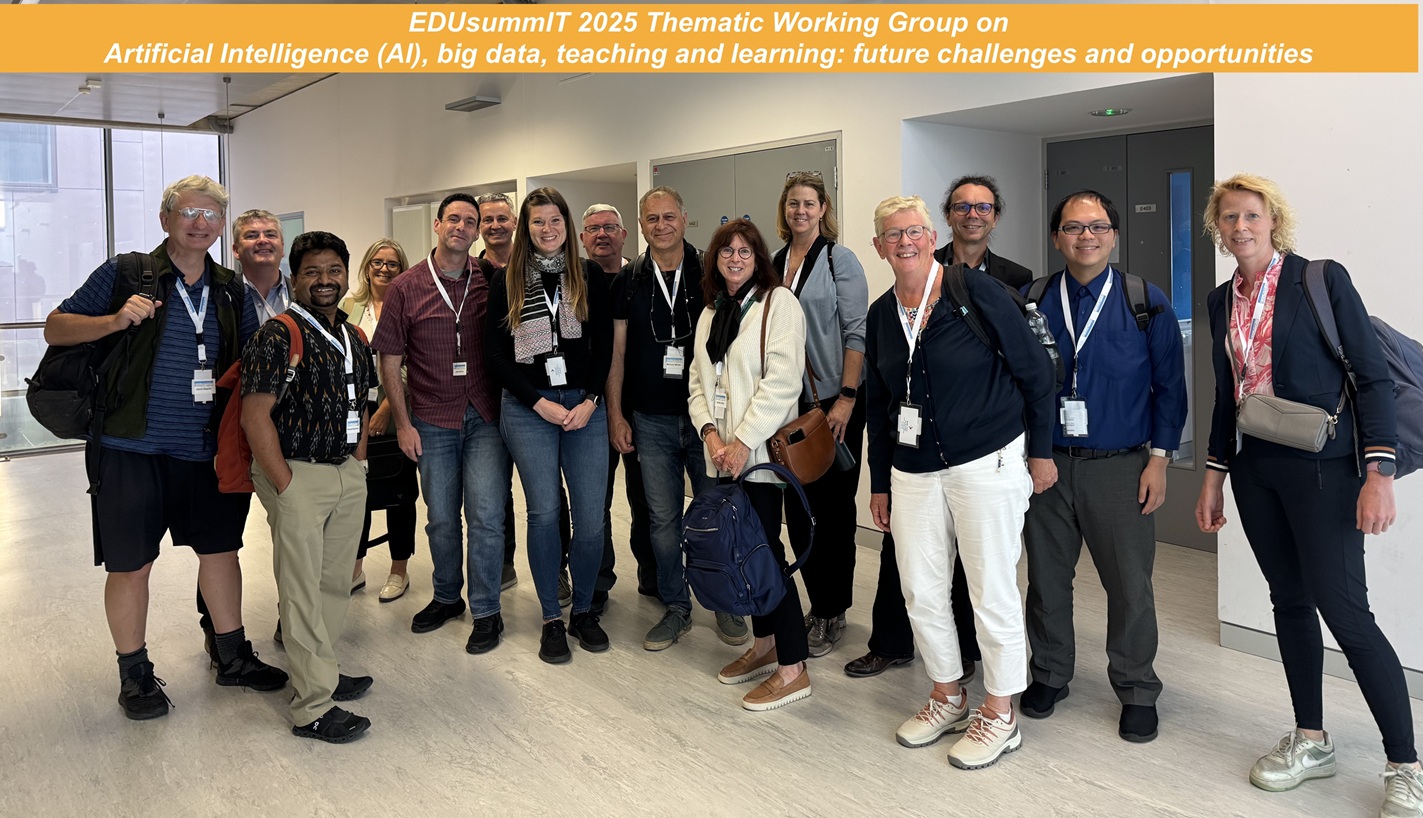
Image Caption: International experts from research, policy and practice who worked on AI-integration strategies and action plan during EDUsummIT 2025 in DCU Institute of Education, Ireland. If you are interested in further exploring the outcomes of various working groups please check the EDUsummIT 2025 handbook available at https://edusummit.info/edusummit-2025-ebook/
Reference
| Authors |
Rwitajit Majumdar*, Dirk Ifenthaler, Clara Schumacher, Enda Donlon, Hsiao-Ping Hsu, Jason Zagami, Maaike Heitink, Wolfgang Mueller *: Corresponding Author |
| Title of original paper |
Fostering collaborative futures: Multidisciplinary approaches to AI integration in educational ecosystems |
| Journal | Computers and Education Open |
| DOI | 10.1016/j.caeo.2026.100405 |