
Incidence of Acute Kidney Injury Is Higher in Summer, Especially Among Young People in Japan

Large-scale health insurance data reveal a seasonal pattern in community-acquired acute kidney injury, highlighting the importance of summer preventionA new study led by researchers at Kumamoto University has found a clear seasonal pattern in community-acquired acute kidney injury (AKI) among people younger than 65 years in Japan, with incidence peaking in summer and showing a larger seasonal increase among those aged 19 years and younger.
AKI is a sudden decline in kidney function that can become serious enough to require hospitalization or dialysis. While AKI is often associated with hospitalized patients, it can also develop in the community, including among people who are otherwise living their everyday lives and visiting outpatient clinics.
The research team analyzed health insurance claims data from approximately 4.28 million people under 65 years of age in Japan, covering the period from August 2016 through July 2018. Among them, 20,634 new cases of community-acquired AKI were identified.
The incidence of AKI increased from June to July and reached its highest level in July. Compared with February, the adjusted incidence rate in July was 19% higher (IRR 1.19). Among people aged 0–19 years, the July incidence rate was approximately 48% higher than in February (IRR 1.48), indicating a larger seasonal variation in this age group.
“Summer is a season when dehydration and heat-related health problems can become more common,” said Yuka Sakazaki, the study’ first author and a doctoral student at Kumamoto University’s Graduate School of Medical Sciences. “Our findings suggest that seasonal factors may be important to consider in AKI prevention, especially given the larger seasonal variation observed among younger people.” added Yuki Kondo, the corresponding author and an Associate Professor at Kumamoto University’s Faculty of Life Sciences.
The researchers caution that the study does not establish that high temperatures or dehydration directly cause AKI. The claims database did not contain laboratory measurements or detailed information on individual heat exposure, temperature, humidity, or other environmental conditions. In addition, AKI was identified using diagnosis codes in insurance claims rather than laboratory-based diagnostic criteria, so differences in diagnosis or coding across seasons cannot be completely excluded.
Future research combining clinical and laboratory data with meteorological information may help clarify how environmental factors contribute to seasonal changes in AKI risk and support the development of prevention strategies tailored to the summer season.
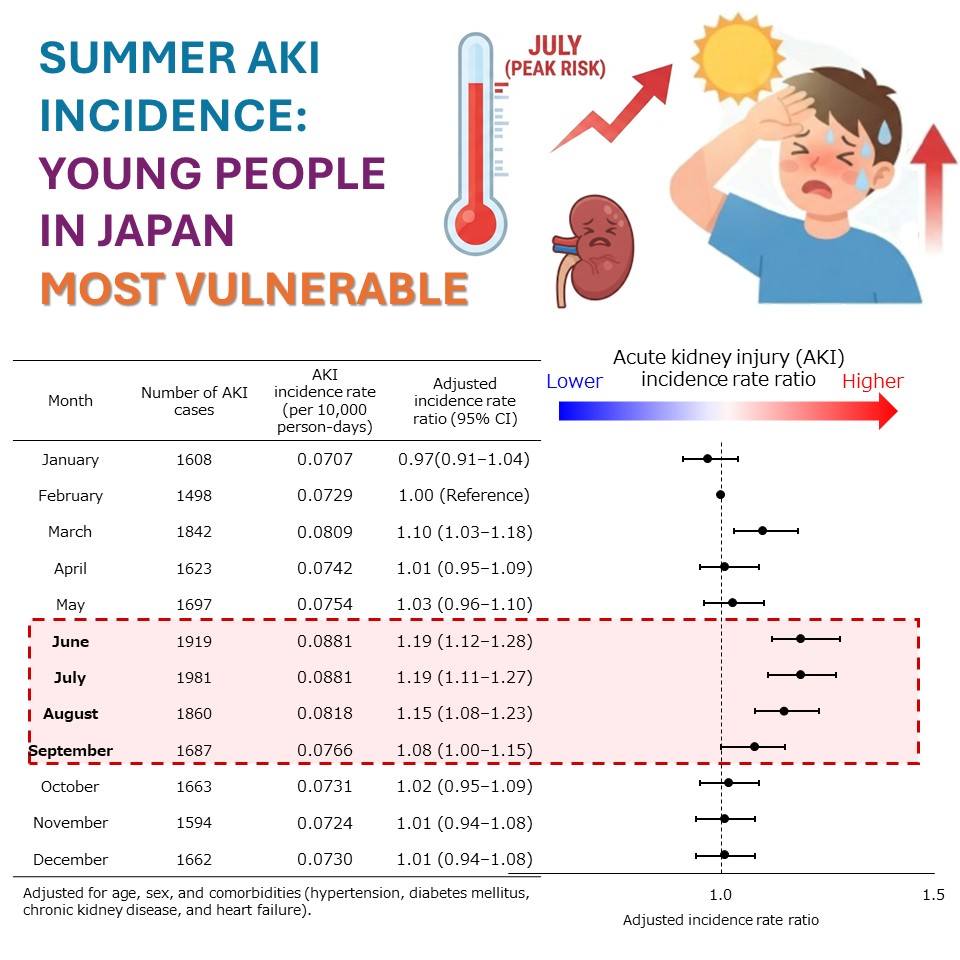
Image Caption: Compared to February, the adjusted incidence rate was significantly higher from June through September, reaching its peak in July and June with an adjusted incidence rate ratio of 1.19. Younger populations, particularly those aged 19 years and younger, showed a larger seasonal increase in AKI incidence during the summer peak.
Reference
| Authors |
Yuka Sakazaki, Yuki Kondo, Mizuki Okuma, Ayaka Seki, Takamasa Sakai, Tetsumi Irie, Yoichi Ishitsuka |
| Title of original paper |
Seasonality of acute kidney injury incidence in Japanese outpatient |
| Journal | Scientific Reports |
| DOI | 10.1038/s41598-026-61190-6 |