
Sliding Sugars Offer Simpler, Smarter Route to Precision Liver-Targeted Therapies

Researchers from Kumamoto University and the National University of Singapore harness polyrotaxane mobility to simplify targeting and boost delivery of gene editors and protein degradersTargeted drug delivery directly to the liver has unlocked major breakthroughs across medicine, but constructing the chemical key to enter liver cells remains complex and costly. Today, researchers at Kumamoto University, in collaboration with the National University of Singapore, have unveiled an elegant, nature-inspired solution that bypasses synthetic bottlenecks by giving single sugar molecules room to move.
For years, targeting the liver's specialized surface receptors—asialoglycoprotein receptors (ASGPR)—required constructing rigid, three-pronged sugar clusters known as triantennary N-acetylgalactosamine (triGalNAc). While effective, synthesizing these intricate architectures demands complex multi-step chemical assembly. Moreover, conventional triGalNAc often struggles to transport heavy biological cargoes, such as gene-editing machinery and large antibody conjugates.
To overcome these hurdles, the team led by Assistant Professor Toru Taharabaru and Associate Professor Taishi Higashi at Kumamoto Unviersity’s Faculty of Life Sciences, engineered a mobile drug delivery platform using polyrotaxanes—supramolecular thread-like polymers where ring-shaped cyclodextrin molecules can freely rotate and slide along a central axle chain. Instead of chemically forcing sugars into a fixed triad, researchers attached simple single sugar units (monoGalNAc) to individual ring molecules. Thanks to the inherent mobility of the polymer backbone, the single sugar rings automatically slide together and self-cluster upon encountering liver receptors, mimicking complex sugar triads without spatial mismatch and enhancing the multivalent interaction.
In comparative cellular studies, this mobile "monoGalNAc-polyrotaxane" achieved cellular uptake efficiency comparable to—and in complex biological serum environments, superior to—conventional triGalNAc systems, while vastly reducing manufacturing complexity.
The team demonstrated the platform's versatility across two cutting-edge therapeutic applications:
- Lysosome-Targeting Antibody Chimeras (LYTACs): Captured circulating target proteins and delivered them to liver lysosomes for degradation with significantly higher efficacy than traditional designs both in vitro and in vivo.
- CRISPR-Cas9 Gene-Editing Nanoparticles: Achieved approximately 25% gene knockdown of the transthyretin (TTR) gene in live mice models following systemic administration.
"By leveraging molecular mobility, we allow the targeting ligands to flexibly adapt to the receptor's structure rather than forcing a rigid synthetic layout," says Dr. Higashi. "This simple yet powerful approach provides a versatile, cost-effective platform to accelerate next-generation liver-targeted gene and protein therapies."
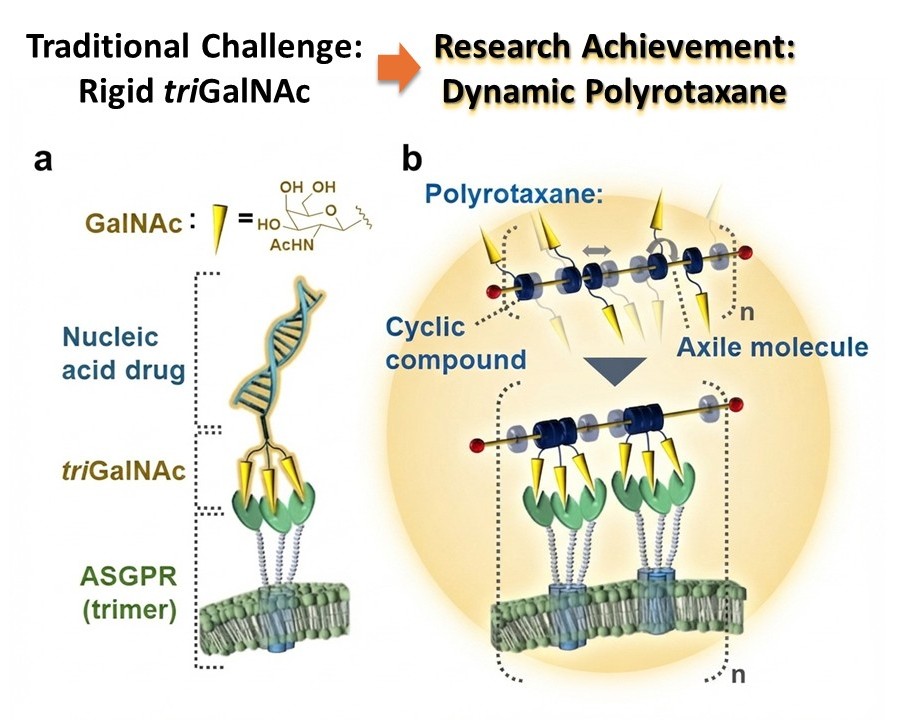
Image Caption: Schematic model comparing the binding of traditional triGalNAc (triantennary) versus polyrotaxane-based monoGalNAc to the trimeric structure of ASGPR (asialoglycoprotein receptor). While conventional approaches required precisely branched triGalNAc, this new model illustrates how modifying a sliding polyrotaxane with multivalent monoGalNAc units allows them to dynamically adjust and bind strongly to the receptor's binding sites.
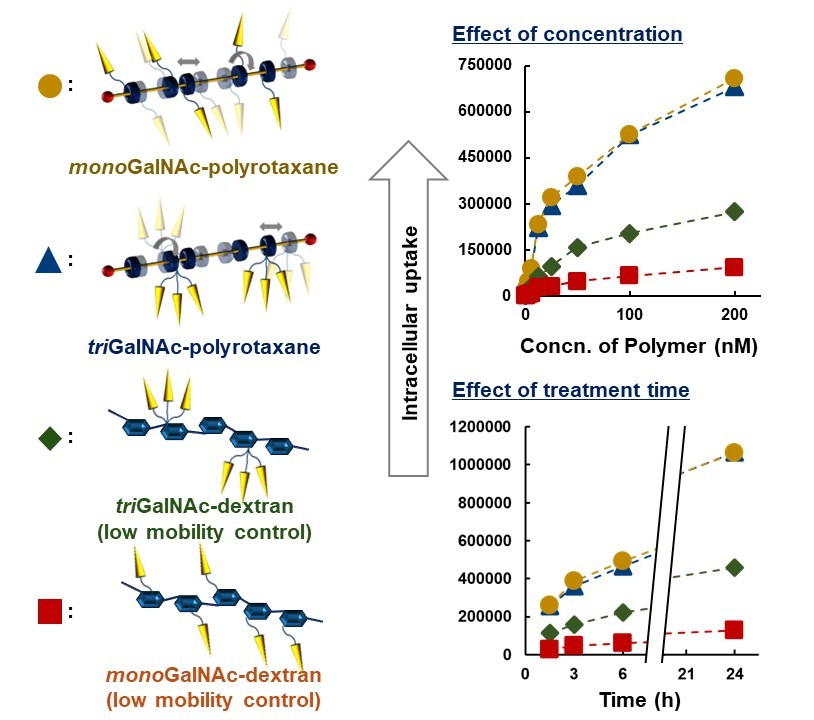
Image Title: Comparison of Cellular Uptake Efficiency Among GalNAc-Modified Polymers and Polyrotaxanes
Image Caption: While conventional non-movable polymers showed significantly lower uptake with monoGalNAc compared to triGalNAc, the polyrotaxane-based systems demonstrated that monoGalNAc-modified polyrotaxane achieved cellular uptake efficiency nearly equivalent to that of triGalNAc-modified polyrotaxane, proving that the dynamic sliding mechanism successfully compensates for the lack of a rigid triantennary structure.
Image Caption: While conventional non-movable polymers showed significantly lower uptake with monoGalNAc compared to triGalNAc, the polyrotaxane-based systems demonstrated that monoGalNAc-modified polyrotaxane achieved cellular uptake efficiency nearly equivalent to that of triGalNAc-modified polyrotaxane, proving that the dynamic sliding mechanism successfully compensates for the lack of a rigid triantennary structure.
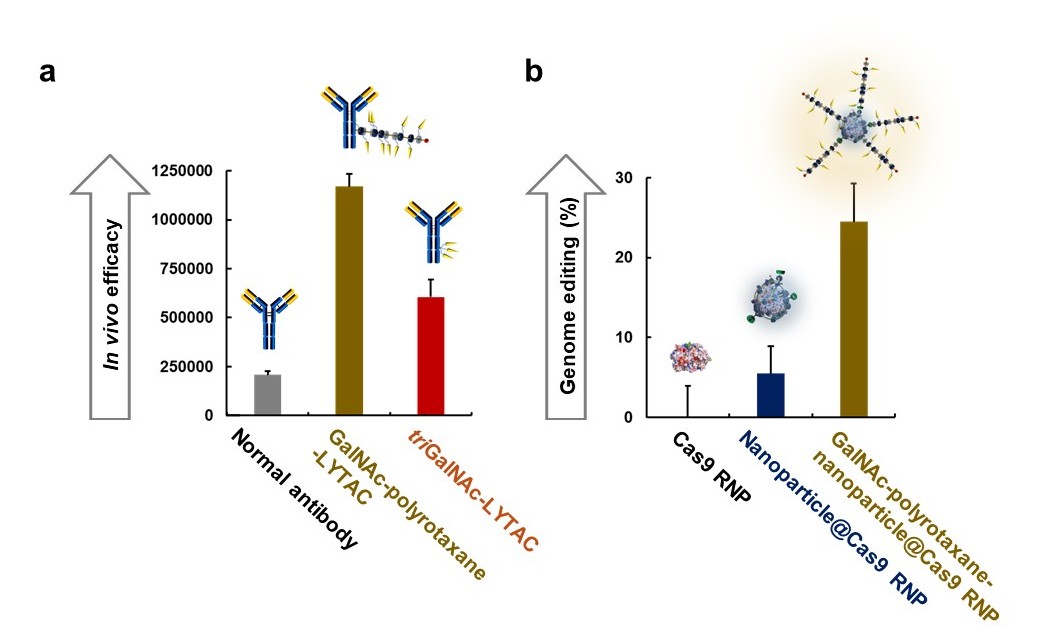
Image Tile: Therapeutic Applications in Next-Generation Biopharmaceuticals: Enhanced LYTAC Activity and Genome Editing Efficiency
Image Caption: Evaluation of the polyrotaxane delivery technology in advanced therapeutic models. (a) Administration of the polyrotaxane-applied LYTAC in mice demonstrated a significantly higher therapeutic effect compared to conventional LYTAC equipped with traditional triGalNAc. (b) Conjugation of monoGalNAc-modified polyrotaxane to Cas9 RNP-loaded nanoparticles successfully improved genome editing efficiency of the target transthyretin (ATTR amyloidosis-causing) gene in the liver.
Reference
Image Caption: Evaluation of the polyrotaxane delivery technology in advanced therapeutic models. (a) Administration of the polyrotaxane-applied LYTAC in mice demonstrated a significantly higher therapeutic effect compared to conventional LYTAC equipped with traditional triGalNAc. (b) Conjugation of monoGalNAc-modified polyrotaxane to Cas9 RNP-loaded nanoparticles successfully improved genome editing efficiency of the target transthyretin (ATTR amyloidosis-causing) gene in the liver.
Reference
| Authors |
Toru Taharabaru, Keiichi Motoyama, Yuting Wen*, Zhongxing Zhang, Xuehao Tian, Jun Li*, Taishi Higashi* *: Corresponding authors |
| Title of original paper |
Molecular Mobility of N -Acetylgalactosamine-Modified Cyclodextrins on a Polyrotaxane for Highly Efficient Liver Targeting of Antibody Chimeras and Genome-Editing Ribonucleoproteins |
| Journal | Advanced Science |
| DOI | 10.1002/advs.75996 |