
Blood Test Shows Promise for Detecting Breast Cancer Recurrence

Kumamoto University researchers develop a minimally invasive approach that reads hidden signals in circulating DNA to distinguish recurrent breast cancerA research team at Kumamoto University has developed a new blood-based approach that could help detect breast cancer recurrence by looking beyond conventional genetic mutations and examining how DNA is packaged inside cells.
The study, published in Cancer Research Communications, analyzed cell-free DNA (cfDNA)—tiny DNA fragments circulating in the bloodstream—from 150 breast cancer samples, including 105 from primary breast cancer and 45 from recurrent or metastatic disease.
Rather than examining only changes in the DNA sequence, the researchers focused on nucleosomes, structures in which DNA is wrapped around proteins called histones. The arrangement of nucleosomes reflects how genes are regulated and how tightly or openly regions of DNA are packaged. This means that blood-derived DNA can carry clues about changes occurring inside cancer cells.
The team targeted 26 genomic regions previously identified as undergoing transcriptional changes when breast cancer cells acquire resistance to hormone therapy. They found that recurrent breast cancer was associated with increased numbers of genetic variants and shorter cfDNA fragments.
Particularly striking were two genomic regions, RERE and SYNPO2. A nucleosome-based score derived from these regions distinguished primary from recurrent breast cancer with an area under the curve (AUC) of 0.826, indicating strong discriminatory performance in this study. Combining nucleosome information with other cfDNA features using machine learning further improved recurrence prediction.
The findings suggest that cfDNA may provide more than a snapshot of cancer mutations: it may also reveal changes in gene regulation and chromatin structure associated with treatment resistance and recurrence.
Because cfDNA can be obtained from a blood sample, the approach could eventually contribute to low-invasive monitoring of patients during and after treatment, potentially supporting earlier detection of recurrence and more personalized treatment decisions.
However, the researchers emphasize that the study was based on a relatively limited retrospective cohort, and differences in breast cancer subtypes and patient backgrounds between the groups need to be addressed. Larger, prospective studies will be necessary to establish how broadly the approach can be applied in clinical practice.
The study was led by Associate Professor Sugiko Watanabe and Professor Mitsuyoshi Nakao of Kumamoto University’s Institute of Molecular Embryology and Genetics (IMEG), together with Yutaka Yamamoto of Kumamoto University Hospital and researchers from partner institutions.
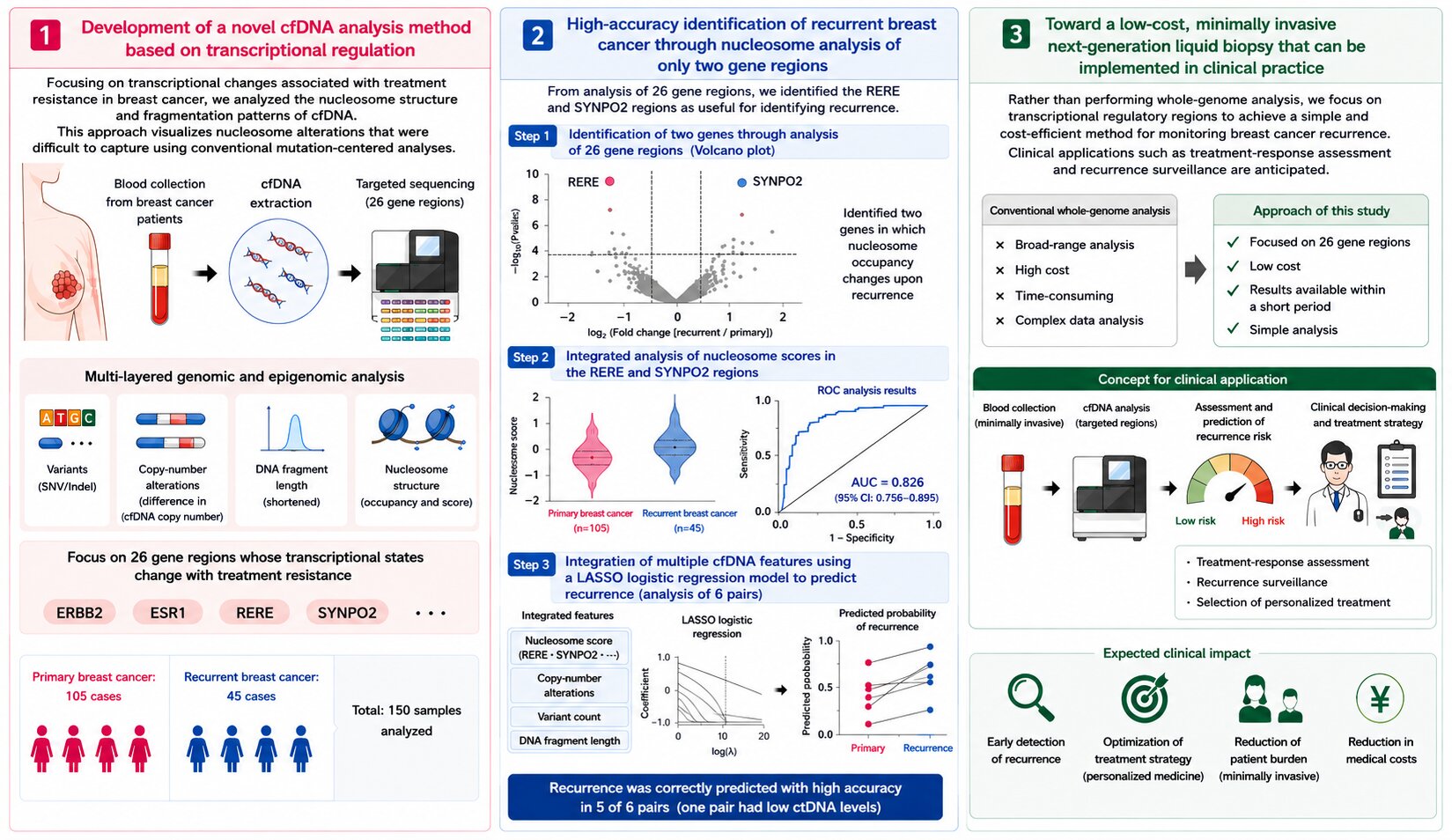
Image Title: Unlocking Hidden Signals in Blood: New Liquid Biopsy Approach Distinguishes Recurrent Breast Cancer via Cell-Free DNA Nucleosome Analysis
Image Caption: Overview of the novel cell-free DNA (cfDNA) analysis method for detecting breast cancer recurrence. 1) Method Development: Researchers analyzed 150 blood samples (105 primary and 45 recurrent/metastatic breast cancer) focusing on nucleosome structures and fragmentation patterns across 26 gene regions associated with treatment resistance. 2) High-Accuracy Identification: By analyzing nucleosome occupancy in specific target regions (RERE and SYNPO2), the team successfully distinguished primary from recurrent breast cancer with an AUC of 0.826, further enhanced by machine learning models. 3)Clinical Potential: This low-cost, minimally invasive liquid biopsy approach paves the way for early recurrence surveillance, treatment-response assessment, and more personalized clinical decisions.
Reference
| Authors |
Sugiko Watanabe*, Kan Etoh, Jun Mitsui, Yuta Suzuki, Yutaka Yamamoto, and Mitsuyoshi Nakao* *: Corresponding authors |
| Title of original paper |
Transcriptionally informed nucleosome profiling of circulating cell-free DNA predicts breast cancer recurrence |
| Journal | Cancer Research Communications |
| DOI | 10.1158/2767-9764.CRC-26-0263 |