
Treating hepatitis C in former medical experiment chimpanzees

Antiviral therapy developed for humans used to successfully treat our primate relativesAs close relatives of humans, chimpanzees had sometimes been used in biomedical experiments. They were instrumental in the identification of the hepatitis C virus: the then mysterious pathogen was artificially injected into chimpanzees for study, leading to its eventual identification in 1989. Since then, treatments for humans have advanced and hepatitis C can now be nearly cured with medication. However, the same treatment has not been extended to the chimpanzees.
In 2022, a team of researchers from Kyoto University found that chimpanzees infected with hepatitis C had experienced negative health effects and shorter lifespans. The study was conducted out of a deep sense of responsibility to prioritize the health and welfare of the chimpanzees and do whatever was necessary to improve their condition. Determined to address this, a collaborative research group-including Professor Yasuhito Tanaka of Kumamoto University Graduate School of Medical Sciences and researchers of Kyoto University’s Wildlife Research Center and - set out to eliminate this virus in chimpanzees residing at Kumamoto Sanctuary. The sanctuary is home to several chimpanzees who were once used in medical experiments by multiple organizations in Japan, and is a place where they can spend the rest of their lives being cared for.
After the team's first study, eight chimpanzees at the sanctuary with chronic hepatitis C infections were still alive. Two crowdfunding campaigns allowed the researchers to purchase the costly medication developed for humans and administer it to the chimpanzees. Before treatment, the team evaluated their liver conditions with blood tests to determine the treatment regimen and duration. Three chimpanzees received an 8-week course of medication, four received a 12-week course, and one needed a 24-week course. The researchers ground the tablet-form medication into a powder and mixed it into steamed sweet potato balls or juice.
Following the treatment periods and then again 6 months later, the researchers collected blood samples to check for the presence of hepatitis C. The results revealed that the virus was successfully eliminated in six chimpanzees but still detectable in the other two, possibly due to mutations associated with drug resistance. Upon completion of the drug regimen the team also thoroughly examined the chimpanzees' livers and found that three had tumors. Unfortunately, two of them subsequently died of liver cancer. But for the chimpanzees who responded successfully to treatment, liver function and health values improved.
This marks the first instance in which hepatitis C virus has been successfully eliminated in chimpanzees for therapeutic purposes.
Reflecting on the study's broader implications, Professor Yasuhito Tanaka noted: "While it is a major medical and welfare achievement to demonstrate that human antiviral medications can effectively clear hepatitis C in chimpanzees, our findings also reveal the harsh reality of long-term infection, including drug-resistant variants and the delayed onset of liver cancer. There are still chimpanzees in Europe and the United States suffering from chronic hepatitis C infections, and we sincerely hope this study serves as a catalyst to improve their welfare worldwide."
Kumamoto Sanctuary currently houses 47 chimpanzees, including those involved in this study. The research team remains dedicated to continuing their efforts toward ensuring the health, care, and welfare of every individual at the facility.

Image 1: Chimpanzee "Shoubo" celebrating recovery. A successful drug treatment for Hepatitis C was celebrated with a feast of mangoes and other treats. Credit: Kumamoto Sanctuary
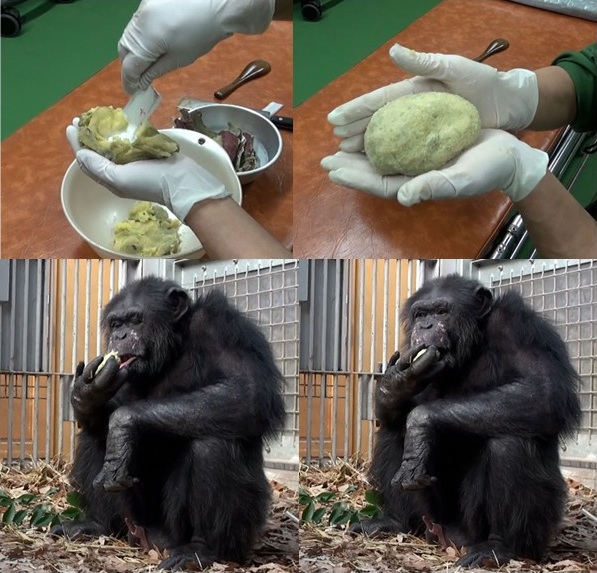
Image 2: Chimpanzee "Yukio" eating a sweet potato dumpling containing medicine. Because the medication was in tablet form and impossible to administer directly to the chimpanzee, it was pulverized into a powder and given by mixing it into rolled steamed potato dumplings or juice
Reference
| Authors |
Satoshi Hirata, Etsuko Nogami, Toshifumi Udono, Michiko Fujisawa, Yasuhito Tanaka |
| Title of original paper |
Direct-acting antiviral therapy and hepatocellular carcinoma in captive chimpanzees with long-standing chronic hepatitis C virus infection |
| Journal | Journal of Medical Virology |
| DOI | 10.1002/jmv.71074 |