
Cardiac CT Scans See the Future: Visualizing "Invisible" Heart Risks

Kumamoto University researchers discover that combining two advanced heart imaging techniques can predict life-threatening cardiovascular events with high accuracy.A routine heart scan might soon do more than just check for clogged arteries; it could act as a crystal ball for your cardiac health. Researchers at Kumamoto University have revealed that by combining two specific markers from a standard cardiac Computed Tomography (CT) scan, they can identify patients at the highest risk for future heart failure and death.
Traditionally, cardiac CT is used to find blockages in the coronary arteries. However, the team led by Professors Yasuhiro Izumiya and Kenichi Tsujita found that the scan can also detect "invisible" damage to the heart muscle itself. By adding a "delayed phase" to the scan, they measured two indicators: Late Iodine Enhancement (LIE), which spots localized scarring, and Extracellular Volume (ECV) fraction, which detects more widespread, subtle damage throughout the heart muscle.
In a study of 1,207 patients followed over an average of 26 months, the researchers discovered that these markers are powerful predictors of a patient’s future. Patients who showed abnormalities in both LIE and ECV were at a significantly higher risk for unplanned hospitalizations or death.
"While these two markers provide different types of pathological information, combining them allows us to detect potential heart damage that might otherwise be missed," the researchers noted.
This breakthrough means that a single, non-invasive CT scan can now provide a "synergistic" view of heart health. It offers a faster, more accessible alternative to expensive and time-consuming MRIs, allowing doctors to intervene earlier with life-saving treatments.
As medical technology advances, the heart CT scan is evolving from a simple diagnostic tool into a vital instrument for long-term health management, ensuring that "hidden" risks are brought to light before they become emergencies.
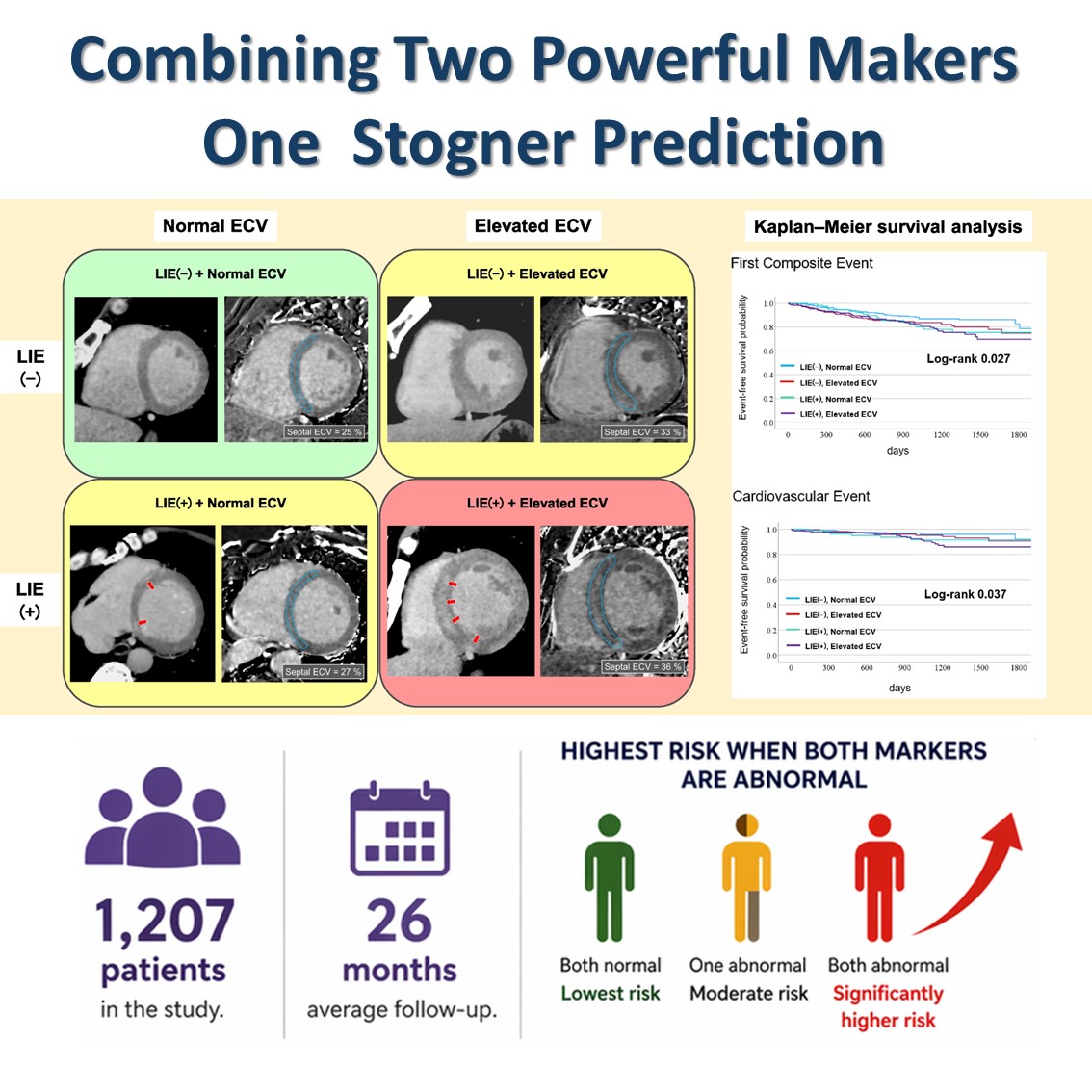
Image Title: Cardiac CT Reveals Hidden Heart Damage to Predict Future Risk
Image Caption: A standard cardiac CT scan enhanced with a delayed imaging phase can detect both visible scarring and subtle, widespread damage in the heart muscle. By combining two markers—Late Iodine Enhancement (LIE) and Extracellular Volume (ECV)—researchers show that a single, non-invasive scan can identify patients at higher risk of future heart failure, hospitalization, or death, enabling earlier and more targeted treatment. Adapted from Oguni et al., European Heart Journal-Cardiovascular Imaging (2026), licensed under Creative Commons Attribution 4.0 International (CC BY 4.0).
Image Caption: A standard cardiac CT scan enhanced with a delayed imaging phase can detect both visible scarring and subtle, widespread damage in the heart muscle. By combining two markers—Late Iodine Enhancement (LIE) and Extracellular Volume (ECV)—researchers show that a single, non-invasive scan can identify patients at higher risk of future heart failure, hospitalization, or death, enabling earlier and more targeted treatment. Adapted from Oguni et al., European Heart Journal-Cardiovascular Imaging (2026), licensed under Creative Commons Attribution 4.0 International (CC BY 4.0).
Reference
| Authors |
Tetsuya Oguni, Yasuhiro Izumiya, Seitaro Oda, Seij Takashio, Yosuke Matsumoto, Naoto Kuyama, Shinsuke Hanatani, Hiroki Usuku, Yasushi Matsuzawa, Masafumi Kidoh, Eiichiro Yamamoto, Toshinori Hirai, and Kenichi Tsujita |
| Title of original paper |
Does adding a delayed phase to cardiac computed tomography for coronary artery evaluation have prognostic value? |
| Journal | European Heart Journal-Cardiovascular Imaging |
| DOI | 10.1093/ehjci/jeag018 |