
HIV drug lenacapavir found to disrupt virus formation, creating giant non-infectious particles

Joint Japanese research reveals a second mechanism behind the drug’s powerful antiviral activity, offering new insights for developing next-generation HIV treatmentsLenacapavir is a powerful, long-acting drug used to prevent and treat HIV infection. While it is known to block key steps in the virus’s replication after entering a cell, researchers have now uncovered another way the drug works: it disrupts the formation of new virus particles, causing them to become abnormally large and non-infectious.
The study, published in Proceedings of the National Academy of Sciences (PNAS) on September 3, 2026, was conducted through a collaboration involving Kumamoto University, Hamamatsu University School of Medicine, the University of Miyazaki, the National Hospital Organization Nagoya Medical Center, and Tokyo University of Technology.
Led by Lecturer Kazuaki Monde of Kumamoto University and Professor Yasumasa Iwatani of Hamamatsu University School of Medicine, the research team investigated how lenacapavir affects HIV-1 during the late stages of its life cycle, when new virus particles are assembled and released from infected cells.
The researchers found that lenacapavir binds not only to the mature capsid protein but also to its precursor, a protein called Gag, which helps build new virus particles. This interaction disrupts normal particle assembly and promotes the formation of unusually large virus-like particles measuring more than 200 nanometers in diameter—considerably larger than typical HIV particles, which are generally around 100–130 nanometers.
“An important and unexpected finding of our study is that lenacapavir can bind to both precursor Gag and mature Gag, despite differences in their structures and assembly states,” said Dr. Monde.
Although the abnormal particles can still fuse with and enter target cells, they cannot establish productive infection. The findings indicate that lenacapavir interferes with HIV at more than one stage of its life cycle, including during the formation of new virus particles.
By revealing this previously unclear mechanism, the study deepens understanding of how lenacapavir exerts its potent antiviral effects. The researchers hope that these insights will help guide the development of improved capsid-targeting drugs and next-generation HIV treatments.
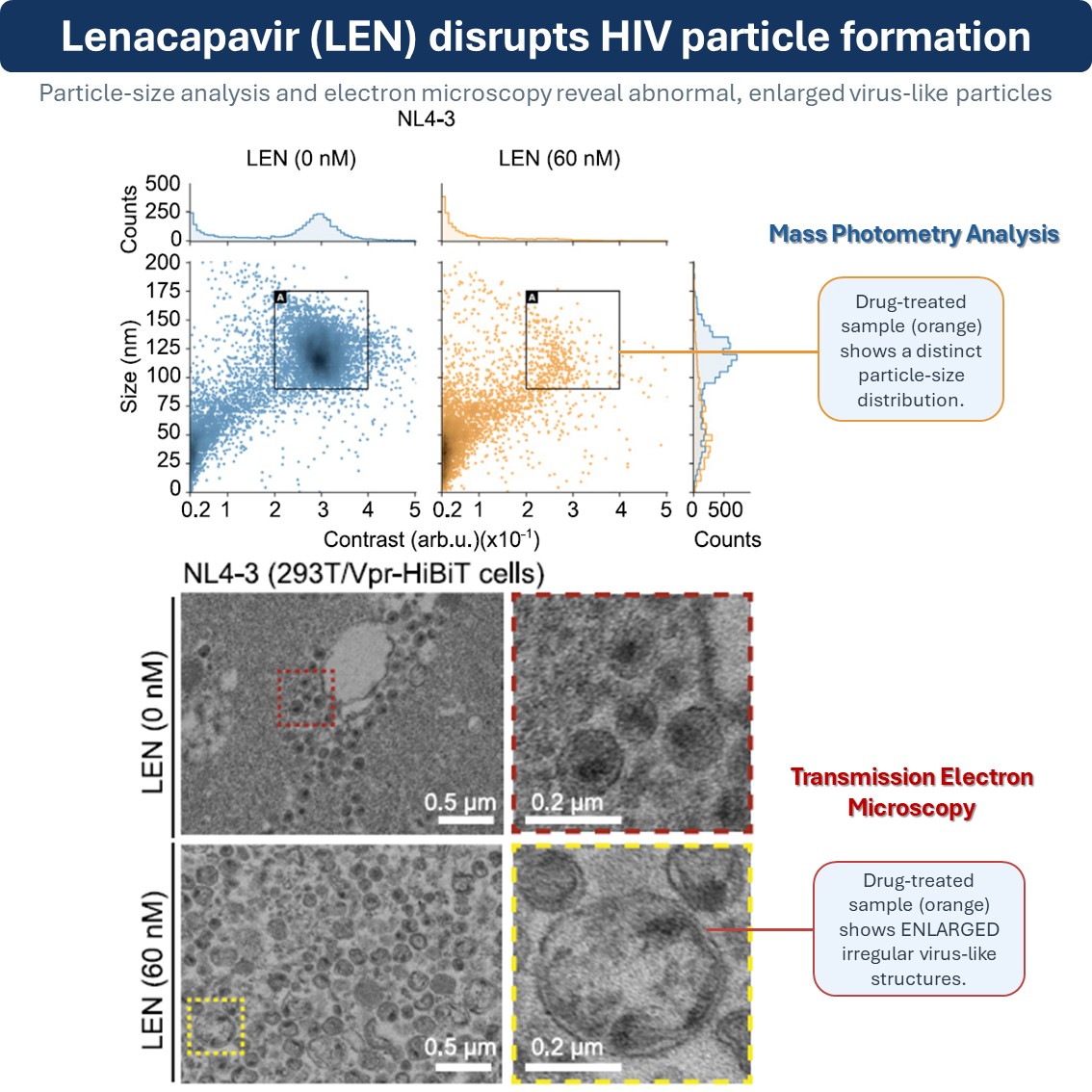
Image Caption: Combining single-particle mass photometry (top) and transmission electron microscopy (bottom), researchers show how the antiretroviral drug lenacapavir (LEN) interferes with the late stages of HIV-1 particle formation. Under normal conditions (LEN 0 nM, blue), HIV-1 forms uniform, spherical particles roughly 100 to 130 nanometers in diameter. When treated with LEN (60 nM, orange), the drug binds to Gag, a protein that helps build HIV-1 particles, and disrupts orderly assembly, drastically reducing the number of normal-sized particles. Electron microscopy reveals that LEN instead triggers the formation of enlarged, irregularly shaped "LEN-induced virus-like particles" (LENiVLPs) exceeding 200 nanometers in diameter. Although these giant particles contain viral proteins (Gag and envelope glycoproteins) and can still attach to and fuse with host cells, structural defects prevent them from replicating, rendering them noninfectious.
Credit: Adapted from Amesimeku et al., Proceedings of the National Academy of Sciences (PNAS), 2026, https://doi.org/10.1073/pnas.2609634123, with permission from the authors. Originally published under the CC BY-NC-ND 4.0 license.
Reference
| Authors |
Wright Andrews Ofotsu Amesimeku, Yoshihiro Nakata, Nami Monde, Hiromi Terasawa, Hirotaka Ode, Hiroyuki Sasaki, Consolata Elias Rukondo, Takeshi Matsui, Perpetual Nyame, Md. Jakir Hossain, Akatsuki Saito, Tomohiro Sawa, Terumasa Ikeda, Yosuke Maeda, Yasumasa Iwatani, Kazuaki Monde |
| Title of original paper |
Lenacapavir binding to immature Gag induces giant virions and causes proteasedependent inhibition of viral release |
| Journal | PNAS |
| DOI | 10.1073/pnas.2609634123 |