
Metals Become Stronger and More Ductile with a Millisecond Electric Pulse

~A new processing method pushes titanium alloys beyond conventional limits in just milliseconds~(Key Points)
- A rapid, low-energy materials processing method using pulsed electric current has been developed
- Non-equilibrium control※1 of crystal microstructures significantly enhances the toughness※2 of titanium alloys
- A new materials design strategy based on athermal effects※3 of electric current is proposed
(Summary)
A research team led by Assistant Professor Shaojie Gu from the Magnesium Research Center, Kumamoto University, together with Professor Yuhki Toku and Professor Yasuyuki Morita (Faculty of Advanced Science and Technology, Kumamoto University), Associate Professor Yasuhiro Kimura (Faculty of Engineering, Kyushu University), Associate Professor Yi Cui (Graduate School of Engineering, Nagoya University), and Professor Yang Ju of Zhejiang University (Visiting Professor at Kumamoto University), has developed a novel method that dramatically enhances the strength and toughness of titanium alloys using an electric current applied for only a few milliseconds.
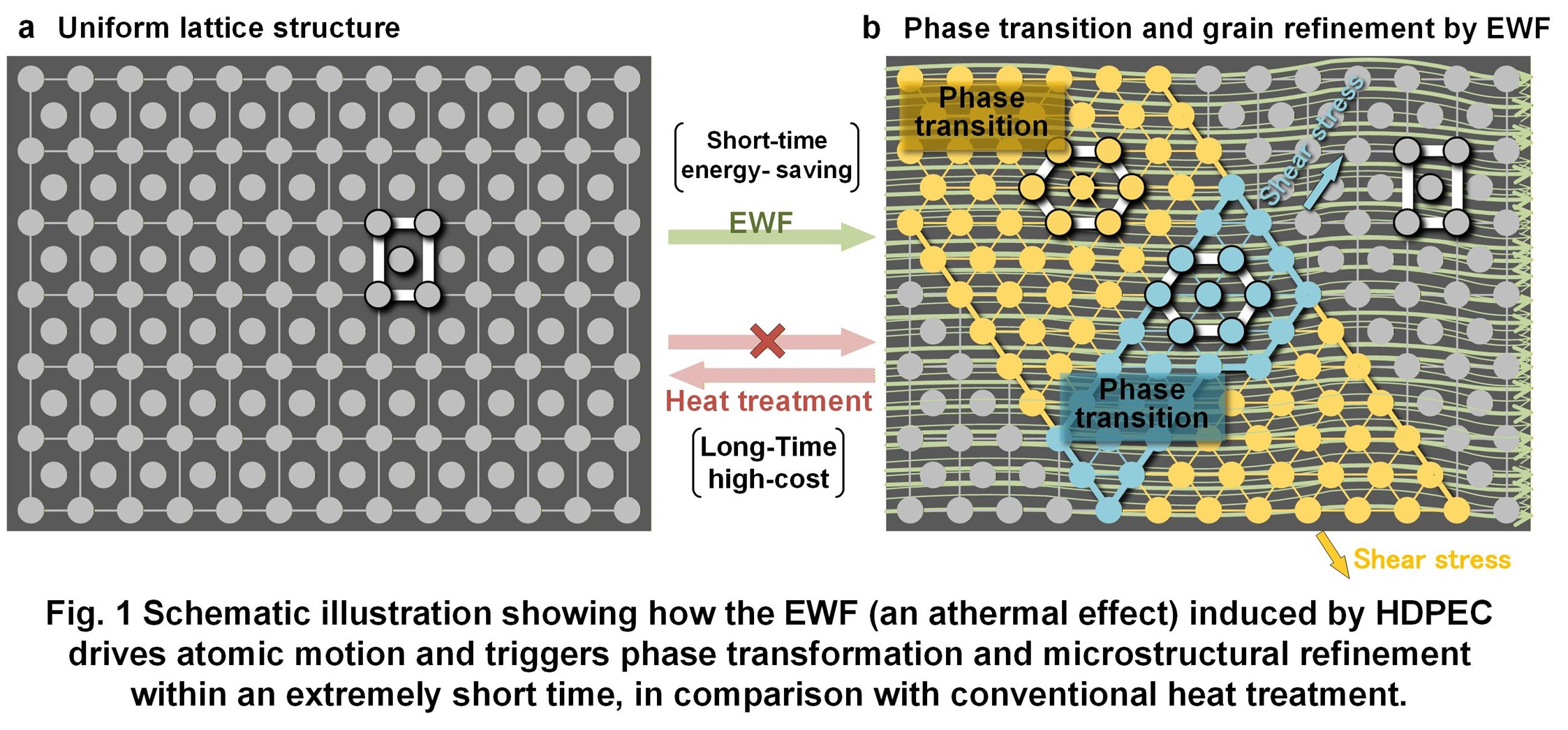
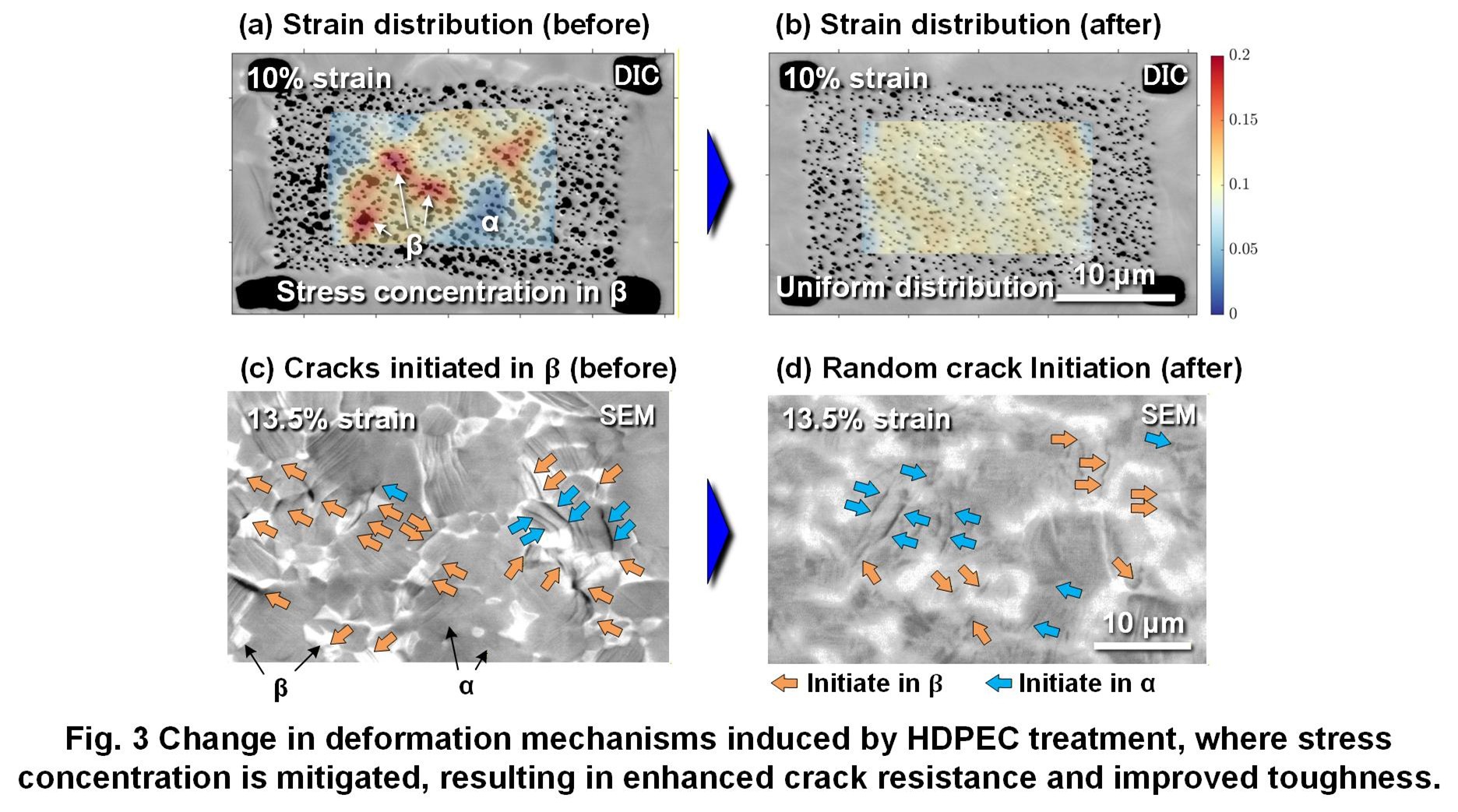
In this study, a high-density pulsed electric current※4 (HDPEC) treatment was applied to dual-phase titanium alloys, instantaneously inducing non-equilibrium atomic diffusion and phase transformations, thereby achieving microstructural refinement and multiphase formation. As a result, the toughness of the material was improved by up to 30%. Unlike conventional heat treatments, this method uniquely exploits the electron wind force※3 (a non-thermal effect), in which electrons flowing through the material directly drive atomic motion. Through this mechanism, overall energy consumption was reduced by more than 50%.
These findings are expected to enable an innovative and energy-efficient processing route for high-performance titanium materials used in applications such as aerospace structural components and artificial joints.
The research results were published in the international academic journal Nature Communications on April 13, 2026.
This work was supported by research funding from the Japan Science and Technology Agency (JST), JSPS KAKENHI, and the Magnesium Research Center, Kumamoto University.
(Detailed information)
[Background]
Titanium alloys are widely used in aerospace and biomedical fields because of their high strength and excellent corrosion resistance. However, conventional heat treatments used to tailor their mechanical properties require long processing times and high energy consumption, limiting efficiency and sustainability.
[Research Details]
This study focused on the impact force exerted by high-density pulsed electric current (HDPEC) on atomic arrangements in titanium alloys, namely the electron wind force, as shown in Fig. 1. This force induces athermal atomic diffusion, enabling the formation of heterogeneous multiphase microstructures※5 without relying on prolonged heating. By precisely controlling current density and pulse duration, the team systematically investigated the microstructural evolution and mechanical properties of Ti-6Al-4V and Ti-6Al-7Nb alloys.
[Key Findings]
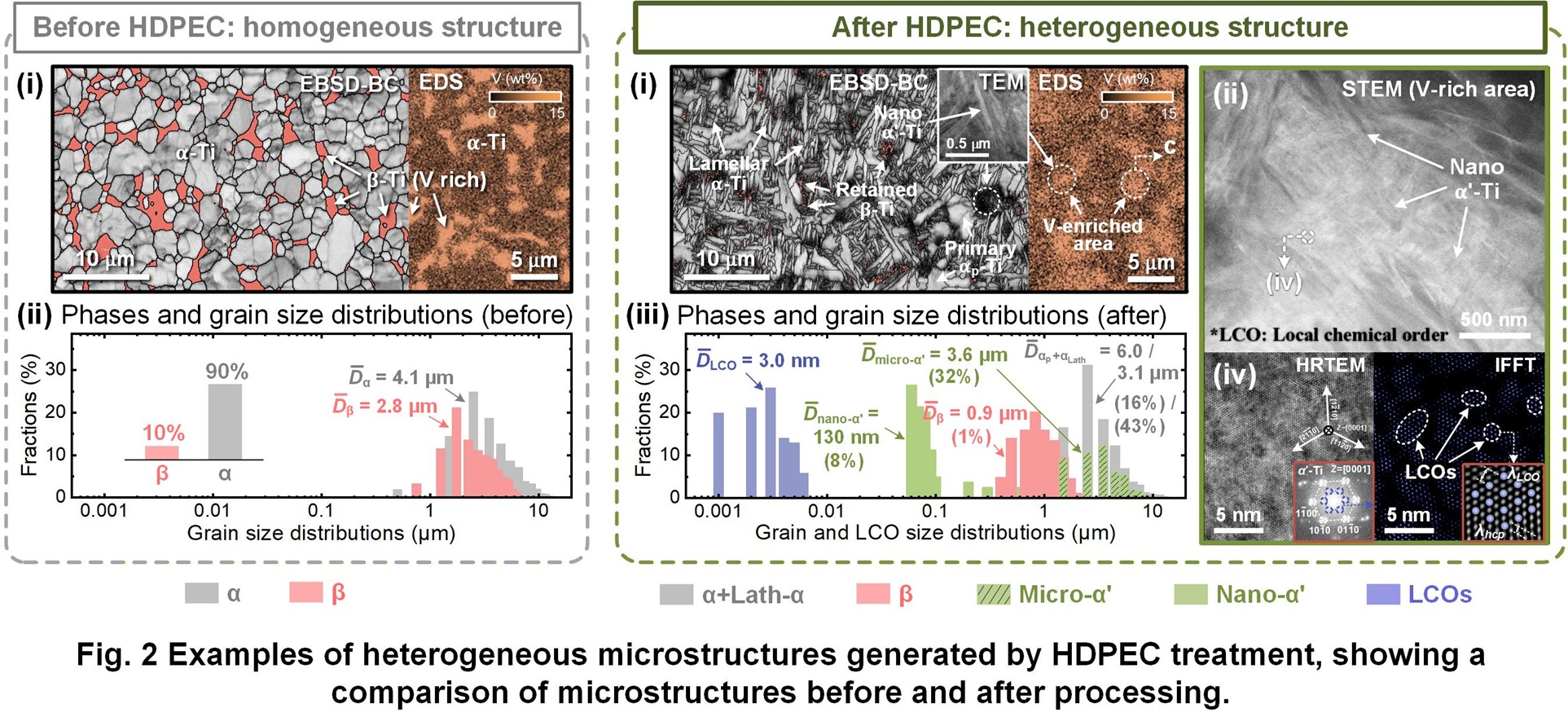
Under various current densities, limited diffusion of β-phase stabilizing elements (V and Nb) was consistently promoted by athermal effects, leading to the formation of refined multiphase microstructures (Fig. 2).
Specifically:
- Nanoscale martensitic phases formed within the β phase, contributing to strength enhancement
- Lamellar structures developed around the β phase, improving ductility
- Ti-6Al-4V alloy: ~30% increase
- Ti-6Al-7Nb alloy: ~26% increase
[Future Outlook]
Beyond titanium alloys, this research demonstrates a broadly applicable, energy-efficient alternative to conventional heat treatment. The findings suggest that HDPEC-driven non-equilibrium microstructure control could be extended to a wide range of metallic materials, offering a new paradigm in advanced materials processing and design.
[Glossary]
※1 Non-equilibrium control: A method of intentionally inducing atomic diffusion or phase transformations before a material reaches thermodynamic equilibrium.
※2 Toughness: A mechanical property describing a material’s ability to absorb energy and resist fracture, reflecting a balance between strength and ductility.
※3 Athermal effects: Effects caused directly by the flow of electrons, rather than by Joule heating; a representative example is the electron wind force.
※4 High-density pulsed electric current: A processing technique that introduces intense electron wind force into metals by applying a high-density electric current for a very short duration.
※5 Multiphase microstructure: A microstructure consisting of multiple crystal phases, often leading to improved strength and toughness.
(Publication Information)
Title:Electric current-driven heterogeneous microstructures in dual-phase titanium alloys
Authors:Shaojie Gu†*, Yasuhiro Kimura*, Yi Cui, Yasuyuki Morita*, Sora Isoi, Chang Liu, Xinming Yan, Bingfeng Ju, Huayong Yang, Yuhki Toku†*, Yang Ju†* (†:equal contribution,*: equal correspondence)
Journal:Nature Communications
doi: 10.1038/s41467-026-70561-6
URL:https://rdcu.be/fdb9w
| 【Contact Information】 Kumamoto University Magnesium Research Center Assistant Professor Shaojie Gu Tel: (+81)096-342-3752 e-mail: shaojie.gu@mech.kumamoto-u.ac.jp Faculty of Advanced Science and Technology Professor Yuhki Toku Tel: (+81)096-342-3574 e-mail: toku@mech.kumamoto-u.ac.jp Faculty of Advanced Science and Technology Professor Yasuyuki Morita Tel: (+81)096-342-3777 e-mail: ymorita@kumamoto-u.ac.jp Kyushu University Faculty of Engineering Associate Professor Yasuhiro Kimura Tel: (+81)092-802-3059 e-mail: ykimura@mech.kyushu-u.ac.jp Nagoya University Faculty of Engineering Associate Professor Yi Cui Tel: (+81)052-789-2781 e-mail: yi.cui@mae.nagoya-u.ac.jp Zhejiang University School of Mechanical Engineering Chair Professor Yang Ju Tel: (+86)0571-88982714 e-mail: yang.ju@zju.edu.cn |