
Natural Compound from Pomegranate Leaves Disrupts Disease-Causing Amyloid

Researchers at Kumamoto University identify a plant-derived molecule that breaks down transthyretin amyloid linked to heart and nerve disordersA research team in Kumamoto University has discovered that a natural compound found in pomegranate leaves and branches can directly break down harmful protein aggregates linked to transthyretin (TTR) amyloidosis, a progressive and potentially life-threatening disease affecting the nerves and heart.
The study, published in iScience, identifies 1,2,3,4,6-penta-O-galloyl-β-D-glucose (PGG) as a potent “amyloid disruptor.” TTR amyloidosis occurs when the transport protein transthyretin misfolds and accumulates as insoluble amyloid fibrils in organs. Existing treatments mainly work by stabilizing the normal protein or reducing its production, but they are less effective once amyloid deposits have already formed.
To address this unmet need, the researchers screened 1,509 plant extracts from a natural product library. Extracts derived from pomegranate (Punica granatum) leaves and branches showed particularly strong activity in disrupting pre-formed TTR amyloid fibrils. Further chemical analysis pinpointed PGG as the active component.
Laboratory experiments demonstrated that PGG effectively disassembled amyloid fibrils formed by both mutant and wild-type TTR. Importantly, under the same conditions, it selectively targeted TTR aggregates without disrupting amyloid-β fibrils associated with Alzheimer's disease, suggesting a degree of molecular specificity.
The team also tested PGG in a nematode model (C. elegans) expressing human TTR fragments. Treatment reduced protein deposits and significantly extended both lifespan and healthspan. In addition, PGG successfully disrupted amyloid fibrils isolated from the cardiac tissue of a patient with hereditary TTR amyloidosis, highlighting its potential clinical relevance.
Structural analyses further revealed that multiple galloyl groups attached to a glucose core are essential for activity, providing insight into how the compound interacts with amyloid fibrils at the molecular level.
While further studies are needed to evaluate safety and efficacy in humans, the findings suggest that plant-derived molecules such as PGG could serve as promising lead compounds for next-generation therapies that actively remove pathogenic amyloid deposits, addressing a major unmet need in TTR amyloidosis treatment.
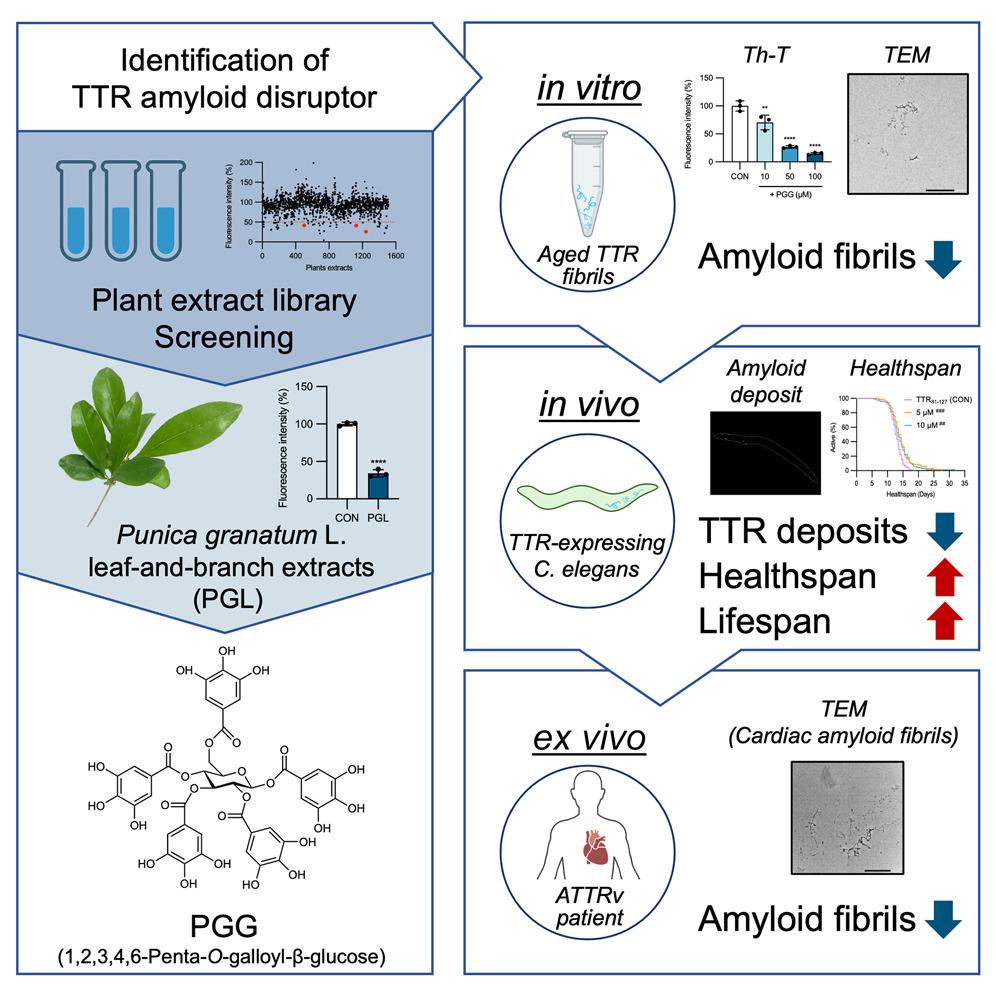
Image Caption: Researchers identified a bioactive compound called PGG (1,2,3,4,6-penta-O-galloyl-β-D-glucose) from pomegranate (Punica granatum) leaf and branch extracts through plant library screening. Laboratory (in vitro), animal model (in vivo), and patient-derived (ex vivo) experiments demonstrated that PGG breaks down transthyretin (TTR) amyloid fibrils, reduces amyloid deposits, and improves healthspan and lifespan in a TTR-expressing C. elegans model. These findings suggest a promising natural approach for targeting TTR amyloidosis.
Image from Kagami A. et al., “Glycosidic scaffold bearing multiple galloyl moieties from pomegranate disrupts transthyretin amyloids,” iScience (2026). Licensed under CC BY 4.0.
Reference
| Authors |
Asuka Kagami, Nami Hashimoto, Ryoko Sasaki, Yutaro Fukushima, Hari Prasad Devkota, Shoya Tanaka, Mikiyo Wada, Kunitoshi Yamanaka, Shiori Yamakawa, Shogo Misumi, Takeshi Yokoyama, Mineyuki Mizuguchi, Takashi Sato, Teruya Nakamura, Shunsuke Kotani, Mary Ann Suico, Hirofumi Kai, Mitsuharu Ueda, Tsuyoshi Shuto* |
| Title of original paper |
Glycosidic scaffold bearing multiple galloyl moieties from pomegranate disrupts transthyretin amyloids |
| Journal | iScience |
| DOI | 10.1016/j.isci.2025.114170 |