


Beyond Fluorine: Scientists Achieve World-Record Performance in Eco-Friendly Graphene Fuel Cells

A breakthrough in "interface engineering" by Kumamoto University clears the path for sustainable, high-power hydrogen energy.As the world races toward a hydrogen-based society, the quest for a truly "green" fuel cell has faced a persistent material hurdle. Most modern fuel cells rely on fluorine-based membranes to conduct protons. While effective, these materials are environmentally taxing and expensive to produce.
Now, a research team at Kumamoto University’s Institute of Industrial Nanomaterials (IINa) has achieved a major milestone in sustainable energy. Led by Assistant Professor Kazuto Hatakeyama and Professor Shintaro Ida, the group has developed a graphene oxide fuel cell that shatters previous performance records for nanosheet-based electrolytes.
Graphene oxide (GO) has long been a "dream material" for fuel cells because it is fluorine-free, environmentally friendly, and possesses a unique dual ability: it conducts protons while simultaneously acting as a powerful barrier against hydrogen gas leaks. However, previous GO fuel cells struggled with low power output because the "interface"—the point where the membrane meets the electrode—created too much electrical resistance.
To solve this, the Kumamoto team pioneered a specialized "interface engineering" technique. By treating the surface of the GO membrane with a targeted acid process, they activated the material’s surface before sandwiching it between electrodes. This simple yet effective modification drastically reduced interface resistance, allowing protons to flow far more freely.
The results, recently published in the Royal Society of Chemistry’s Journal of Materials Chemistry A, are record-breaking. The new fuel cell achieved a maximum power density of 0.7 W/cm² at 40°C—nearly three times the performance of previous nanosheet electrolytes. Remarkably, this eco-friendly cell now rivals the performance of commercial fluorine-based membranes measured under the same conditions.
"This interface design isn't just for graphene oxide," says the research team. "It can be applied to various other nanosheet and polymer membranes, offering a universal strategy to boost fuel cell efficiency." This breakthrough marks a significant step toward a future of high-performance, carbon-neutral energy that is as kind to the planet as it is powerful.
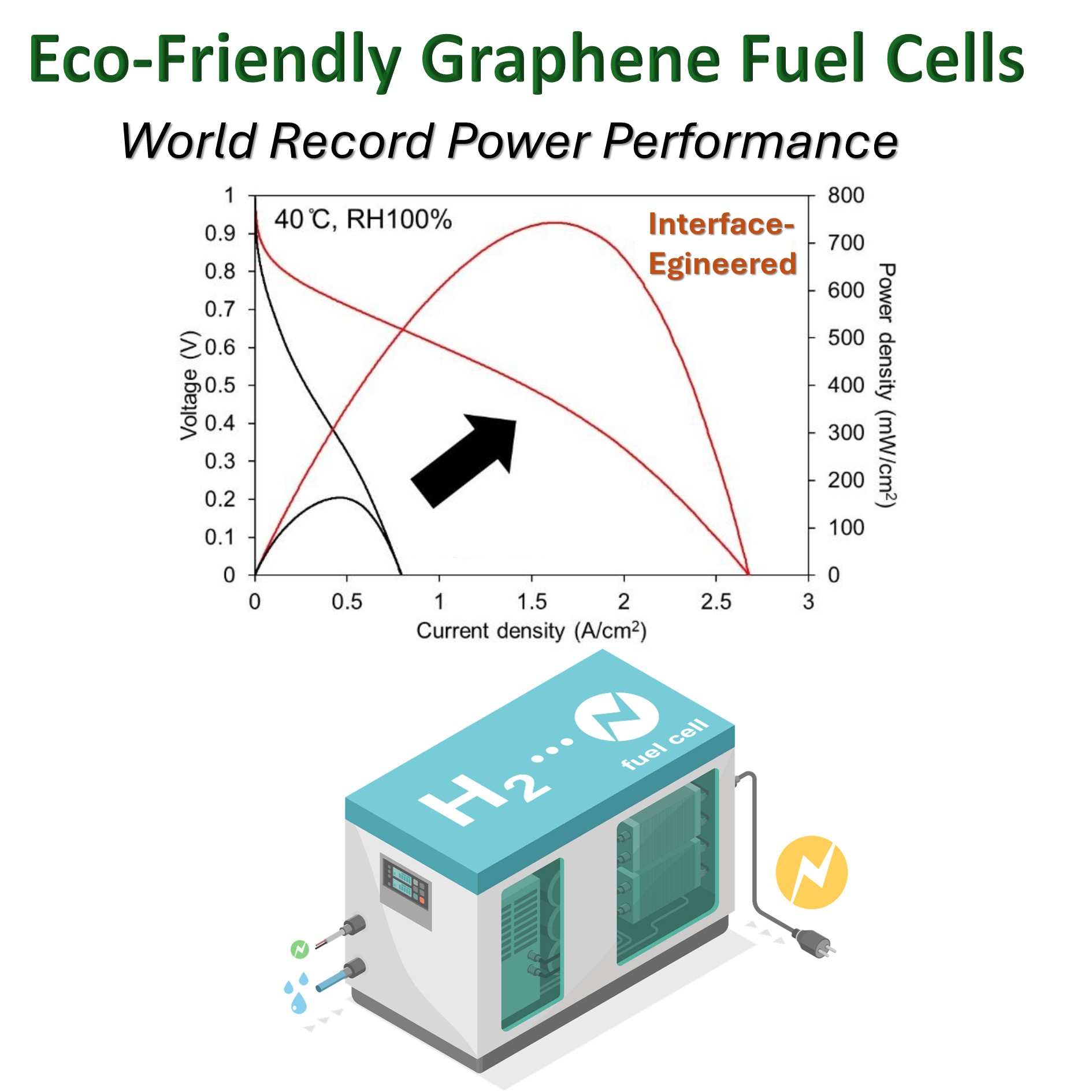
Image Title:
Interface-Engineered Graphene Oxide Fuel Cell Achieves Record Power Density
Image Caption:
By applying a targeted acid treatment to engineer the interface between the GO membrane and electrodes, the team significantly reduced interfacial resistance, enabling efficient proton transport. This design achieves a record power density of 0.7 W/cm² at 40°C, approaching the performance of conventional fluorine-based membranes while offering a more environmentally friendly alternative.
Reference
Interface-Engineered Graphene Oxide Fuel Cell Achieves Record Power Density
Image Caption:
By applying a targeted acid treatment to engineer the interface between the GO membrane and electrodes, the team significantly reduced interfacial resistance, enabling efficient proton transport. This design achieves a record power density of 0.7 W/cm² at 40°C, approaching the performance of conventional fluorine-based membranes while offering a more environmentally friendly alternative.
| Authors |
Tatsuki Tsugawa, Kazuto Hatakeyama*, Kanako Oka, Kaito Takegami, Yuichi Sakuda, Michio Koinuma, Norihiro Moriyama, and Shintaro Ida* |
| Title of original paper |
Interface-Engineered Graphene Oxide Membranes for High-Performance Fluorine-Free Fuel Cells |
| Journal | Journal of Materials Chemistry A |
| DOI | 10.1039/D5TA09184E |