

Fascinated by the Unknown World Beneath the Sea: A New Species of Sea Anemone Living in Symbiosis with Hermit Crabs Discovered

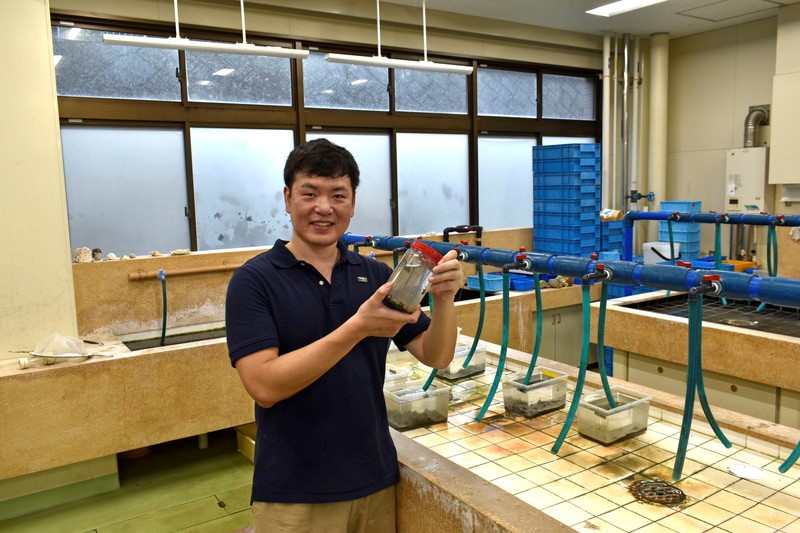
Associate Professor Akihiro Yoshikawa
Aitsu Marine Station, Center for Water Cycle, Marine Environment and Disaster Management
(Concurrent Appointment: Department of Biology, Faculty of Science)
The ocean is full of mysteries, and much about marine life remains unknown. We interviewed Associate Professor Akihiro Yoshikawa, who recently published fascinating research on a new species of sea anemone that lives in symbiosis with hermit crabs.
Unraveling the History of Evolution
A New Species of Sea Anemone Discovered
The recent announcement of a new species of sea anemone has become a hot topic. Please tell us about your research up to now!
I study marine organisms, focusing on the symbiotic relationships between hermit crabs and sea anemones. In particular, I aim to clarify how these relationships have evolved in the deep sea.Some sea anemones live only on the shells used by hermit crabs. Hermit crabs change shells as they grow, and while shallow seas have abundant shells, deep-sea environments often lack usable shells. In the deep sea, certain sea anemones create a “shell-like structure” that expands the living space for hermit crabs, essentially providing them with a “home.”
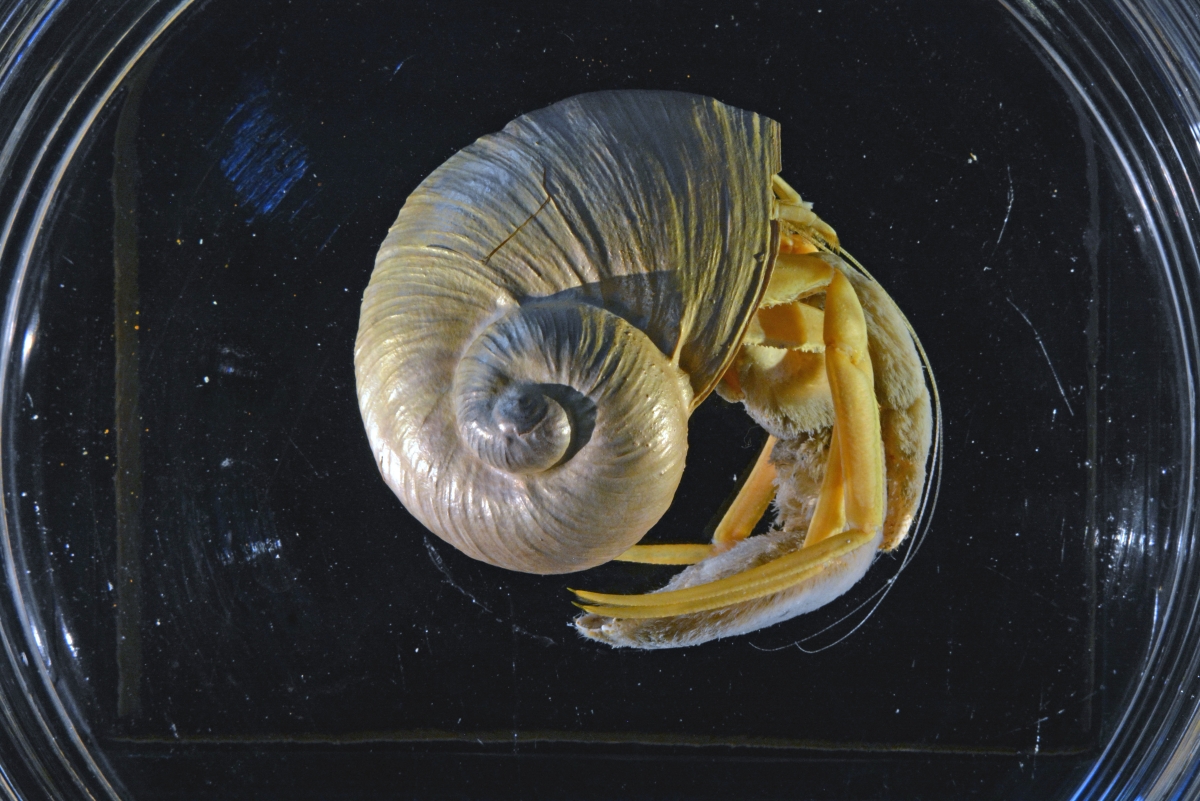
A “shell-like structure” created by a species of Stylobates, providing a “home” for the hermit crab. Specimen from Hawaii (Courtesy of the National Museum of Nature and Science).
Although many of these sea-anemone species are known from overseas, Japan also has a species informally called Stylobates calcifer (ヒメキンカライソギンチャク). It had not been scientifically described, and upon close examination, we found that it was an undescribed species. After analyzing its morphology and DNA, we published it as a new species in 2022.
When reporting a new species, you can name it. So we named it Stylobates calcifer (“Calcifer”), inspired by “Calcifer” from the animated film Howl’s Moving Castle, because the appearance of the anemone attached to a hermit crab resembles the character (laughs).

Stylobates calcifer (“Calcifer”), described as a new species in 2022.
What other hermit crabs and sea anemones live together?
Other types of symbiosis also exist. When hermit crabs change shells, they sometimes detach their sea anemones so that they can move them to the new shell. Don’t you imagine sea anemones clinging on and refusing to let go? But when moving shells, if the hermit crab rhythmically taps around the sea anemone which causes the anemone to detach and move to the new shell. The sea anemone’s tentacles contain toxins that protect hermit crabs from predators such as octopuses, while the anemone gains mobility and access to food. It is thought to be such a symbiotic relationship.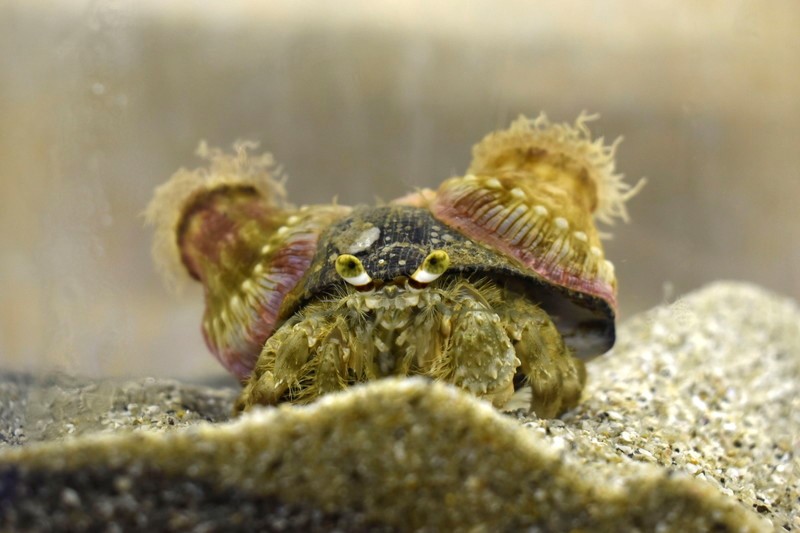
The shallow-water sea anemone Calliactis sp., which lives in symbiosis on hermit crab shells. This species does not create shell-like structures (kept at Aitsu Marine Station).
Do you mean the sea anemones have evolved various abilities through their symbiotic relationship with hermit crabs?
I believe so. Species that build shell-like structures, or those that move themselves in sync with the hermit crab's “relocations”—I think each has evolved unique symbiotic patterns suited to their living environment. As a researcher, I find it deeply intriguing that we don't yet understand how sea anemones, with their very simple body structure, achieve this. How symbiosis with hermit crabs led to such unique evolution is a fascinating research topic.The Long Journey to Publishing a Paper.
Perseverance is the surest path.

Associate Professor Yoshikawa caring for hermit crabs at Aitsu Marine Station.
What was it like when you discovered the new species?
Many marine organisms are known but not formally recognized. Although Stylobates calcifer was informally acknowledged, no scientific paper existed. Publishing such findings is important so that researchers worldwide can recognize them.My encounter with the species happened by chance. I collected sea anemones from the deep sea and placed them in a tank when one suddenly started to “run.” Upon observing closely, I saw a hermit crab hidden inside, living within the anemone’s “home.” This surprising moment inspired me to continue the research.
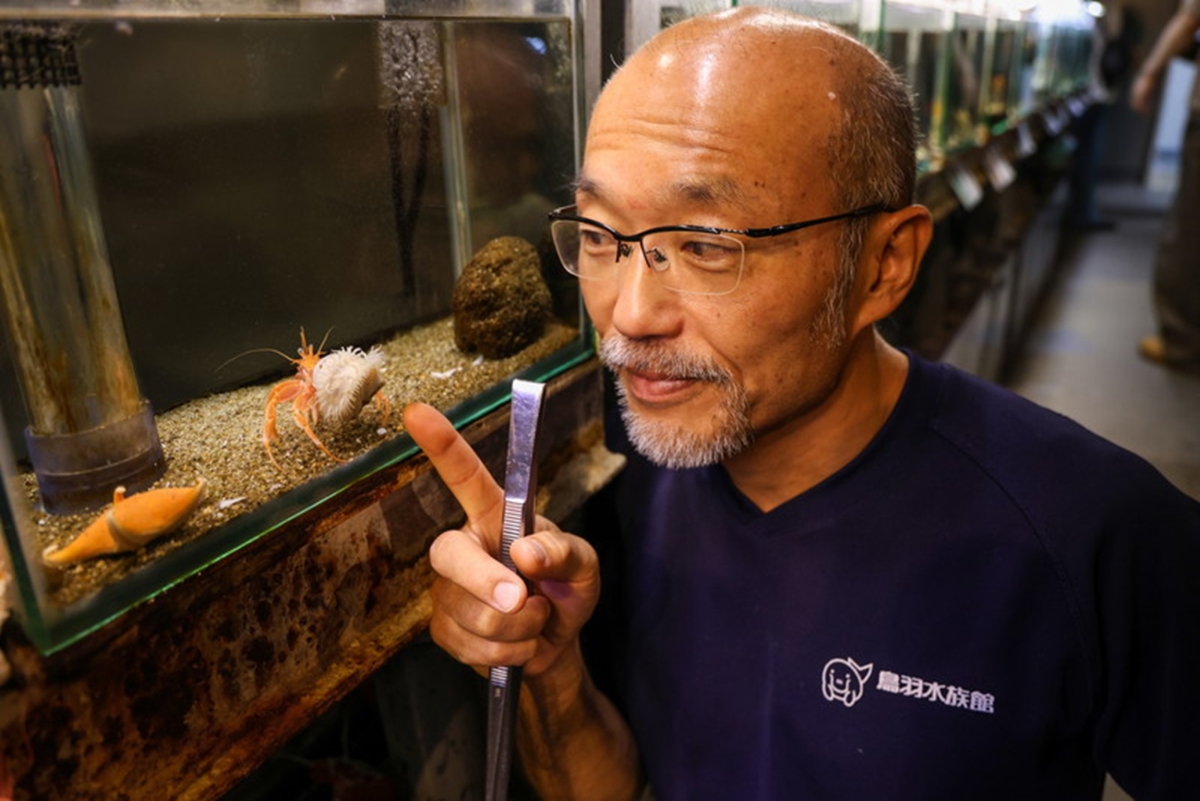
Stylobates calcifer (“Calcifer”) with Mr. Moritaki from Toba Aquarium, a collaborating researcher (Photo courtesy of Toba Aquarium).
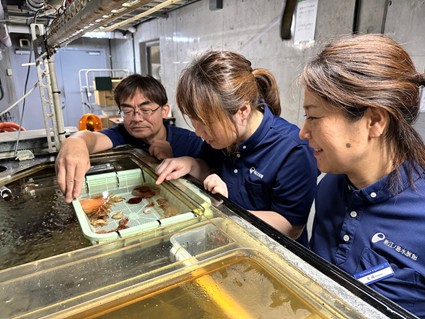
Collaborating researchers from Enoshima Aquarium who support specimen collection (from back to front: Mr. Sugimura, Ms. Kasagawa, and Ms. Kitajima). Research provides opportunities to meet many people (Photo courtesy of Enoshima Aquarium).
Was it announced immediately after the discovery?
It took about five years to publish the paper on Stylobates calcifer, because I researched various aspects. I included not only morphological and DNA analyses but also its feeding behavior and whether hermit crabs moved into it. I compiled information on the ecology of both organisms in the deep sea into a single paper. That’s why it took so long to publish.More recently, I described another new species, the Paracalliactis tsukisome (ツキソメイソギンチャク), which also creates a “home” for hermit crabs. This discovery took about seven years to publish. (For details: https://ewww.kumamoto-u.ac.jp/en/news/838/) I really should have written this paper sooner, but I kept thinking, “Wouldn’t it be better to have more data like this?” or “Wouldn’t it be interesting to analyze it from this angle?” and before I knew, time had flown by (laugh).
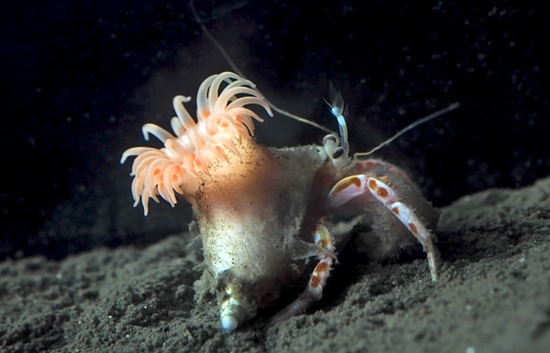
The Paracalliactis tsukisome, described as a new species in October 2025. Its name is derived from a phrase in the Man'yōshū expressing “feeling of affection”
For example, I hypothesized that hermit crabs living symbiotically with anemones that build these “home” might have evolved into larger species than their close relatives. So I investigated, and it turned out that the symbiotic hermit crabs really had evolved into larger species. At that time, I measured a large number of hermit crab specimens stored in museums. Traveling all the way to the Queensland Museum in Australia just to measure one specimen is a really good memory. I had a hard time getting by with my English (laugh).

Conducting research at the specimen collection facility of the Queensland Museum
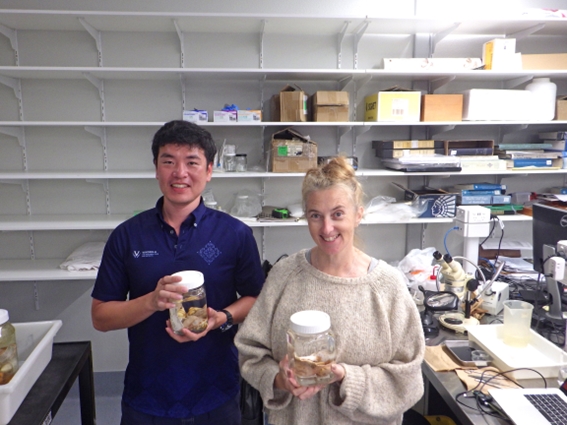
With Dr. Michela, the hosting researcher, at the Queensland Museum in Brisbane, Australia.
While examining 3D data of shells with attached Paracalliactis tsukisome, I suddenly wondered, “Huh? Does this know which way the shell is facing?” I thought, “It should not be able to do that,” but there was a tendency for it to move in a certain direction.
Adult sea anemones essentially possess a body structure called “radial symmetry,” lacking a head, brain, or sense of direction. It is unclear whether they can make judgments like “move forward” or “turn right” as we do. The mechanism by which such anemones develop the behavior of “moving forward” might help us understand how creatures with “brain,” including humans, evolved. Thinking about that makes the story even more fascinating, doesn’t it?
When the paper was accepted, I felt that my long efforts had finally been recognized by researchers around the world. While it might be overturned in the future, I believe that hearing “That might be the case” at this point is the greatest joy for a researcher. When you experience that kind of joy, even the longest years feel like a single moment.
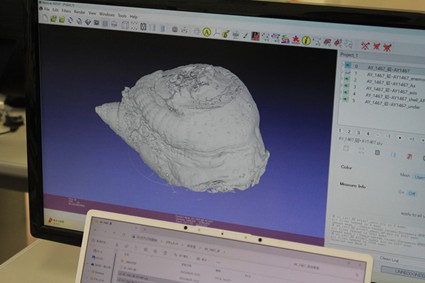
A 3D scan of a hermit crab shell bearing the Paracalliactis tsukisome
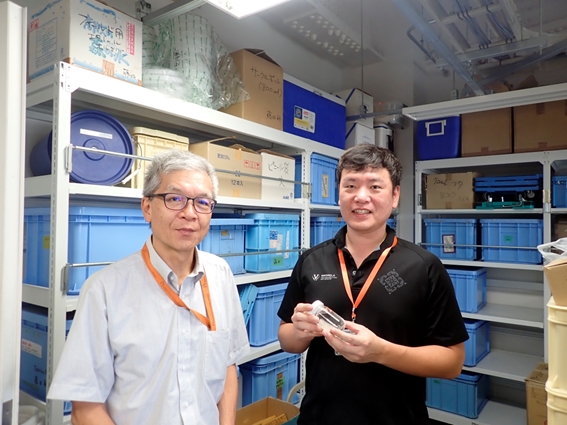
With Dr. Fujita, the hosting researcher during the JSPS PD period, at the National Museum of Nature and Science in Tsukuba, Ibaraki.
Don't set limits on yourself.
Keep challenging yourself to do what you want to do
What made you begin researching marine life?
I guess it was because fishing with my parents was boring (laugh). From around age three, my parents took me to the sea while they fished. Fishing involves a lot of waiting, right? I hated waiting for fish to bite, so I’d play nearby with my mother and sister, catching hermit crabs. Looking back, what I touched then is the same as what I work with now (laughs). That little experience probably led me down the path to becoming a researcher today.I don’t know if I grew up exactly as my parents hoped, but having them take me to the sea definitely sparked my interest in becoming a researcher.
Actually, back in junior high school, I became fascinated with space and wanted to study it someday. I thought it would be amazing to discover life out there.
But then I realized, “Huh, the ocean has so many strangely shaped creatures. It seems just as full of wonder as space.” Humans have walked on the Moon, but no one has walked on the seafloor 1,000 meters deep, right?
I’d always looked beyond Earth, but I started thinking the Earth’s depths seemed fascinating too. That's how I ended up researching life in the ocean, especially deep-sea creatures (after all, Earth is just one planet in the universe). The idea of a place that feels close yet distant, somewhere I want to go but can't, teeming with strange lifeforms, that was incredibly appealing to me.
Someday, I'd be thrilled if an alien civilization read my papers and thought, “So these creatures lived in Earth's deep sea.”
Writing letters to aliens is one of the motivations behind my research.
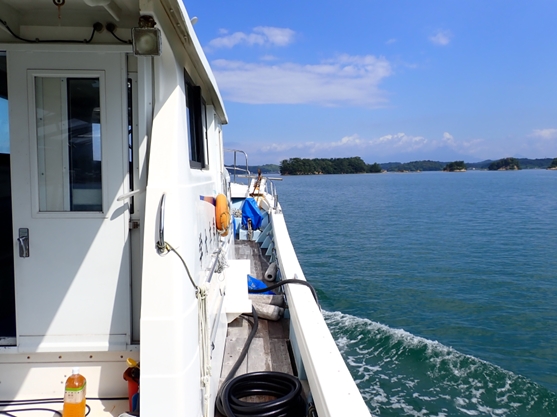
Collecting marine organisms from the seafloor aboard the Aitsu Marine Station vessel “Dolphin SC.”
What do you find most exciting about research?
The most exciting moment is when I notice something and think, “This might be new.” When a seemingly simple sea anemone exhibits unexpected behavior, or when I catch a glimpse of how deep-sea creatures live, that sense of wonder deeply moves me.Of course, research also involves a lot of very tedious work. Like endlessly measuring the length of biological specimens, meticulously formatting figures and tables for papers, or handling procedures for business trips. However, the sense of superiority that comes from knowing I've discovered something exciting, something perhaps only I know in the world right now, makes even those tedious tasks feel enjoyable. And when a paper is published, I imagine that somewhere in the world, someone might be thinking, “This is fascinating!” That might be the greatest pleasure of research.
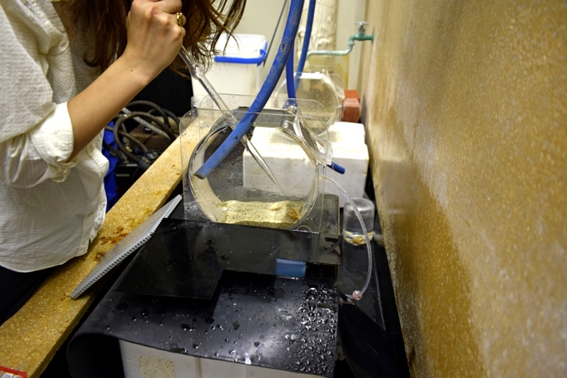
A student caring for hermit crabs used in the research.
Please share a message for the students!
To younger students, I want to say: “Don’t try to do everything alone.” You might imagine research as something done alone in silence, but in reality, I'm making progress by collaborating with many colleagues. I'm not great at statistical analysis, but by teaming up with friends who excel at it, we can move our research forward. On the other hand, I think I'm relatively good at finding the fascination in observing biological behavior and then designing research plans to unravel it (though I'm still inexperienced, so I can't really brag). In this way, I believe that by bringing together the things each of us is a little good at, not just research but life itself becomes richer (laugh).At the same time, do not set limits on yourself. If you didn't get into your dream school during university admissions, that doesn't mean you're a failure. If you have something you want to achieve, don't define yourself solely by test scores or others' opinions. Keep striving toward what you want to do. Of course, it's okay to fail. I believe people who experience all kinds of failures and overcome them become the “experts” in their field.
There may be pressures or expectations that push you away from your dreams. But I hope you will not give up—keep moving toward what you truly want to achieve.
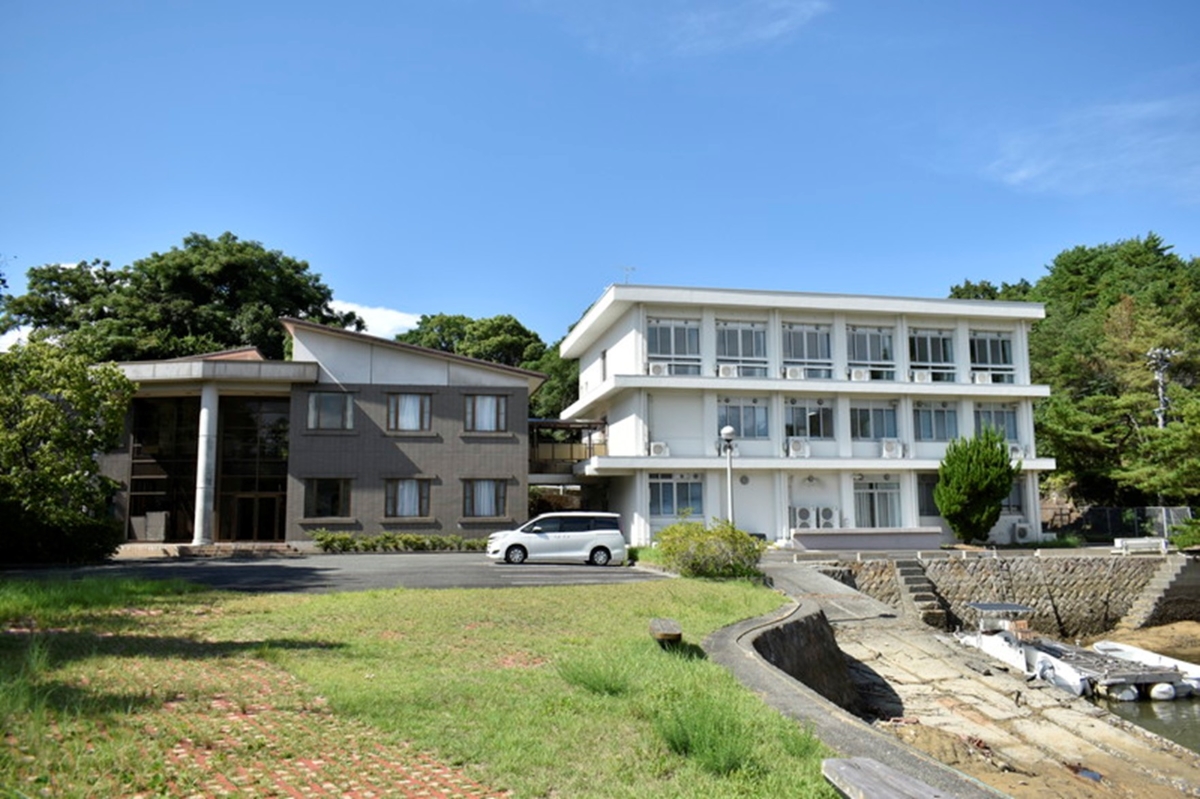
Aitsu Marine Station
Located in Kami-Amakusa City, Aitsu Marine Station serves as a major hub for marine biology research and also provides accommodation. Students in the Department of Biology, Faculty of Science, can also join the laboratory for their thesis research.
If you are interested in Associate Professor Yoshikawa’s research, please feel free to visit his laboratory (He also has a laboratory on the Kurokami Campus).
Website: https://akjktex80.wixsite.com/akihiro-yoshikawa
[Related links]