


Mask-wearing during COVID-19 linked to reduced air pollution–triggered heart attack risk in Japan

Nationwide study of 270,000 patients shows pandemic-era behavior changes significantly lowered PM2.5-associated risk of MINOCA, a non-obstructive type of heart attack
Researchers at Kumamoto University have discovered that behavioral changes during the COVID-19 pandemic—particularly widespread mask-wearing—may have reduced the risk of certain types of heart attacks triggered by air pollution.
The study, led by Dr. Masanobu Ishii and colleagues, was published in the European Society of Cardiology’s flagship journal, European Heart Journal.
Air pollution and heart attacks
Fine particulate matter known as PM2.5—tiny airborne particles small enough to penetrate deep into the lungs—has long been recognized as a major environmental risk factor for cardiovascular disease. Exposure can trigger inflammation, oxidative stress, and blood vessel dysfunction, potentially leading to acute myocardial infarction (AMI), commonly known as a heart attack.
Using Japan’s nationwide cardiovascular database (JROAD-DPC), the research team analyzed data from 270,091 patients hospitalized for AMI between 2012 and 2022. They examined short-term exposure to PM2.5 and compared risks before and during the COVID-19 pandemic, which brought dramatic shifts in public behavior, including mask use and reduced mobility.
Striking decline in a specific heart attack subtype
The researchers found that short-term exposure to PM2.5 significantly increased the risk of all types of AMI. However, one subtype—MINOCA (myocardial infarction with non-obstructive coronary arteries), a heart attack without coronary artery obstruction—showed a particularly strong association with air pollution.
Most notably, after the onset of the pandemic, the PM2.5-related risk of MINOCA significantly declined. In contrast, the risk of the more typical heart attack with coronary artery obstruction (MI-CAD) remained largely unchanged.
The findings suggest that pandemic-related preventive behaviors—especially mask-wearing—may have reduced individual exposure to harmful particulate matter, thereby lowering the risk of pollution-triggered vascular dysfunction such as coronary spasm or microvascular impairment.
Implications for public health
This study provides real-world evidence that simple protective measures can mitigate cardiovascular risks associated with unavoidable environmental exposures. Even in Japan, where no strict lockdowns were imposed, voluntary public health practices appear to have delivered measurable cardiovascular benefits.
The researchers emphasize that improving air quality remains a long-term priority. However, the findings also highlight the potential of accessible interventions—such as mask use during high-pollution periods—to protect vulnerable populations.
As societies confront ongoing environmental challenges, these insights may help shape future preventive cardiology and public health strategies worldwide.
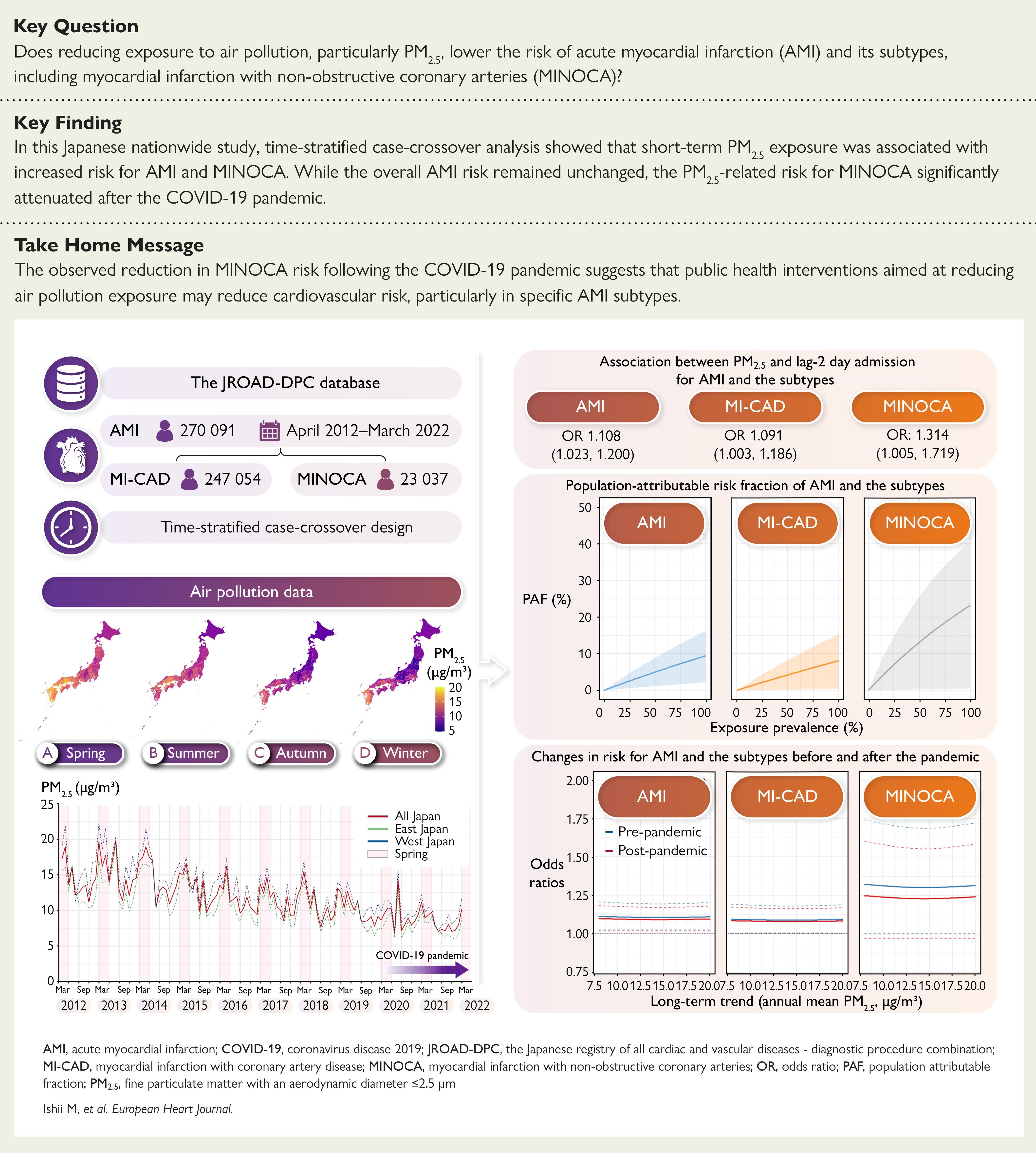
Image Title:
Mask-wearing may have reduced heart attack risk linked to air pollution
Image Caption:
Graphical overview of a nationwide Japanese study (2012–2022) showing that short-term PM2.5 exposure increased hospitalization risk for acute myocardial infarction (AMI), particularly MINOCA. After the onset of the COVID-19 pandemic, the PM2.5-related risk of MINOCA significantly declined, suggesting that behavioral changes such as mask-wearing may have reduced pollution-triggered heart events.
Image from Ishii et al., “Air pollution before and during the COVID-19 pandemic:
changes in risk of acute myocardial infarction,” European Heart Journal (2026). Licensed under CC BY 4.0.
Reference
| Authors |
Masanobu Ishii, Taishi Nakamura, So Ikebe, Yasuhiro Otsuka, and Kenichi Tsujita |
| Title of original paper |
Air pollution before and during the COVID-19 pandemic: changes in risk of acute myocardial infarction |
| Journal | European Heart Journal |
| DOI | 10.1093/eurheartj/ehag102 |